THEY ACT LIKE GROOMING IS IMPORTED
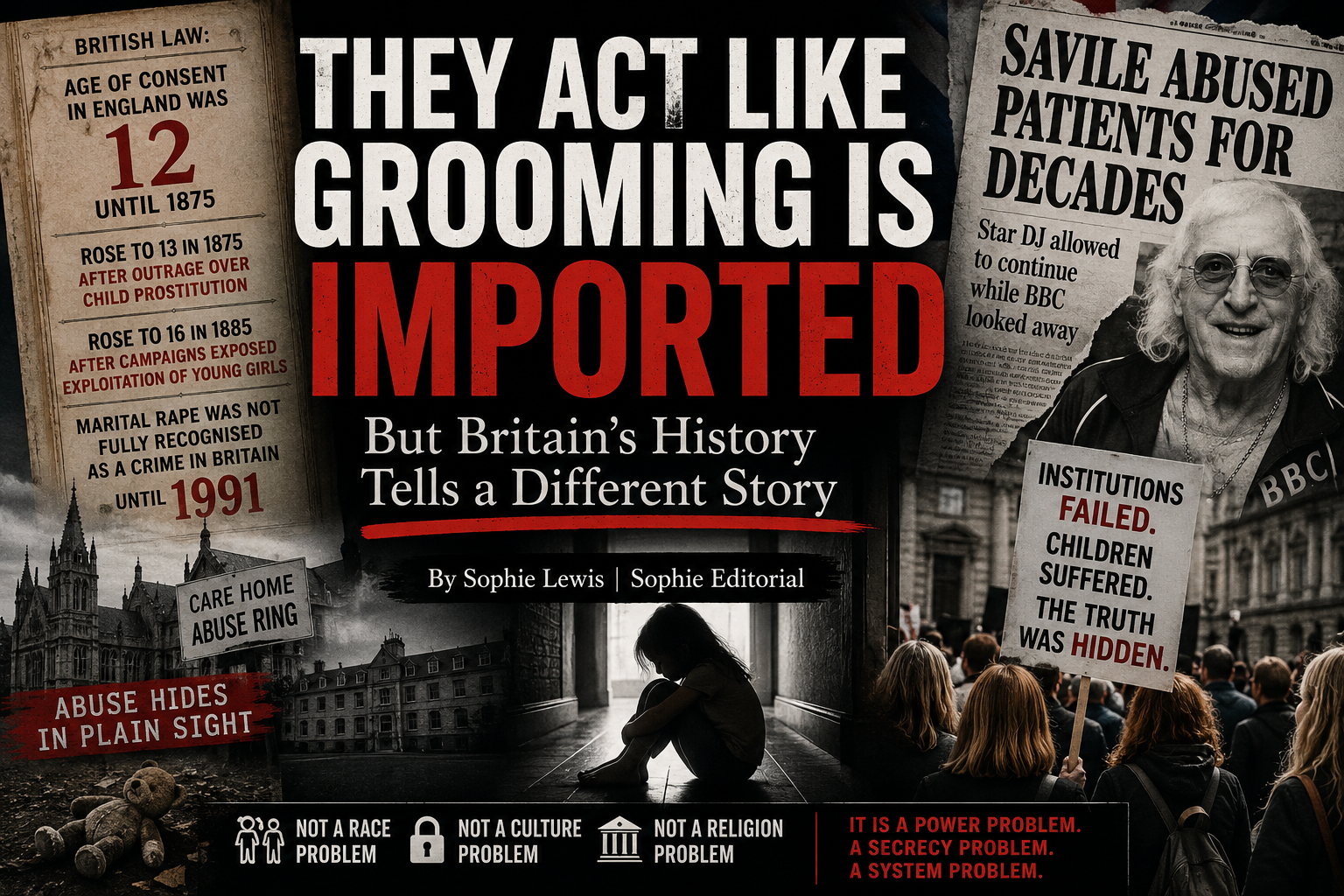
But Britain’s History Tells a Different Story
By Sophie Lewis | Sophie Editorial
Every time another grooming case hits the headlines, the same argument erupts online.
“Send them back.” “It’s their culture.” “This isn’t British.”
It’s worth pausing on that claim. Not to dismiss it, but to actually test it against the evidence. Because if the history of child exploitation in Britain tells us anything, it should inform how we respond to it now.
And the history is uncomfortable.
For most of British history, children had barely any legal protection at all.
The age of consent in England was 12 until 1875. Twelve. It only rose to 13 after public outrage around child prostitution, then finally to 16 in 1885, following campaigns that exposed the industrial-scale exploitation of vulnerable girls in British cities.
Marital rape was not fully recognised as a crime in Britain until 1991. That means there are people alive today who grew up in a legal system where a husband forcing sex on his wife carried no criminal consequence under the law.
These are not ancient footnotes. They are the architecture of a society that, within living memory, did not treat the bodies of women and children as fully their own.
So when the argument runs that exploitation arrived here from elsewhere, history does not support it. Abuse has always existed here, inside wealthy homes, inside churches, inside boarding schools, inside children’s homes run by the state, inside families, inside institutions built specifically to protect the vulnerable.
Jimmy Savile abused patients in NHS hospitals for decades while being celebrated on national television. Organised abuse rings operated in care homes across multiple counties. The Catholic Church, the Church of England, independent schools, football clubs, the BBC, institution after institution has faced credible, documented scandals. The offenders were white, British, often middle-class, often respected. The failures were systemic, not incidental.
None of this proves that culture is irrelevant to abuse. It doesn’t. But it does prove that Britain has no clean baseline to defend.
Here is where the conversation usually gets uncomfortable, and it is worth engaging with honestly rather than sidestepping.
Some cultures, and some ideological systems, do carry harmful attitudes toward women, children, consent and power. Child marriage persists in parts of the world and has been practised within closed communities in Britain itself. Certain religious and cultural frameworks have been used to justify secrecy around abuse, to silence victims, and to protect perpetrators. These things are real, they deserve direct criticism, and refusing to name them is its own form of failure.
The question is not whether culture ever matters. It does. The question is whether a racial explanation for grooming is accurate, and whether treating it as the primary explanation makes children safer or less safe.
The evidence suggests the latter.
When society becomes convinced that exploitation has a particular face, that face becomes the thing people watch for. And the people who don’t fit the profile move more freely.
The football coach trusted with unsupervised access to boys. The family member whose behaviour is explained away. The teacher whose special interest in a particular student goes unremarked. The youth worker whose boundaries are described as just being good with kids. The respected professional whose status makes accusation feel implausible. The teenage peer who shares abuse material through a phone.
These are not edge cases. Statistically, children are most commonly harmed by people known to them, often within their own families or communities, often by people who look like the surrounding majority and hold positions of trust.
The stereotype does not just mislead. It actively functions as cover. When people are scanning for a particular type of offender, everyone else becomes less visible. That is how safeguarding fails, not through ignorance about one group, but through false certainty about which groups to ignore.
Exploitation thrives wherever specific conditions exist: power imbalance, vulnerability, silence, shame, poor intervention and institutional cowardice. These conditions appear across every race, class, religion and postcode. They are the common denominator in every case, without exception.
That does not mean all cultural attitudes are equivalent, or that every institution has failed equally, or that specific patterns within specific communities should go unexamined. They should be examined. Rigorously.
But examined properly, meaning: following evidence, not emotion. Designing policy around what actually protects children, not around what makes a particular group of adults feel their own community is above suspicion.
Because the uncomfortable conclusion, after looking at the full picture, is this:
Child exploitation is not a racial problem. It is a power problem. A secrecy problem. A system problem. A problem that Britain has spent centuries looking away from, long before anyone found a convenient group to blame it on.