SEDATE TO STAY SILENT – Inside the Welsh Care Homes Using Medication to Control Children

©️ An Independent Exposé by Sophie Lewis – Real Talk, Real Tea | The Grooming Files | The Indie Leaks
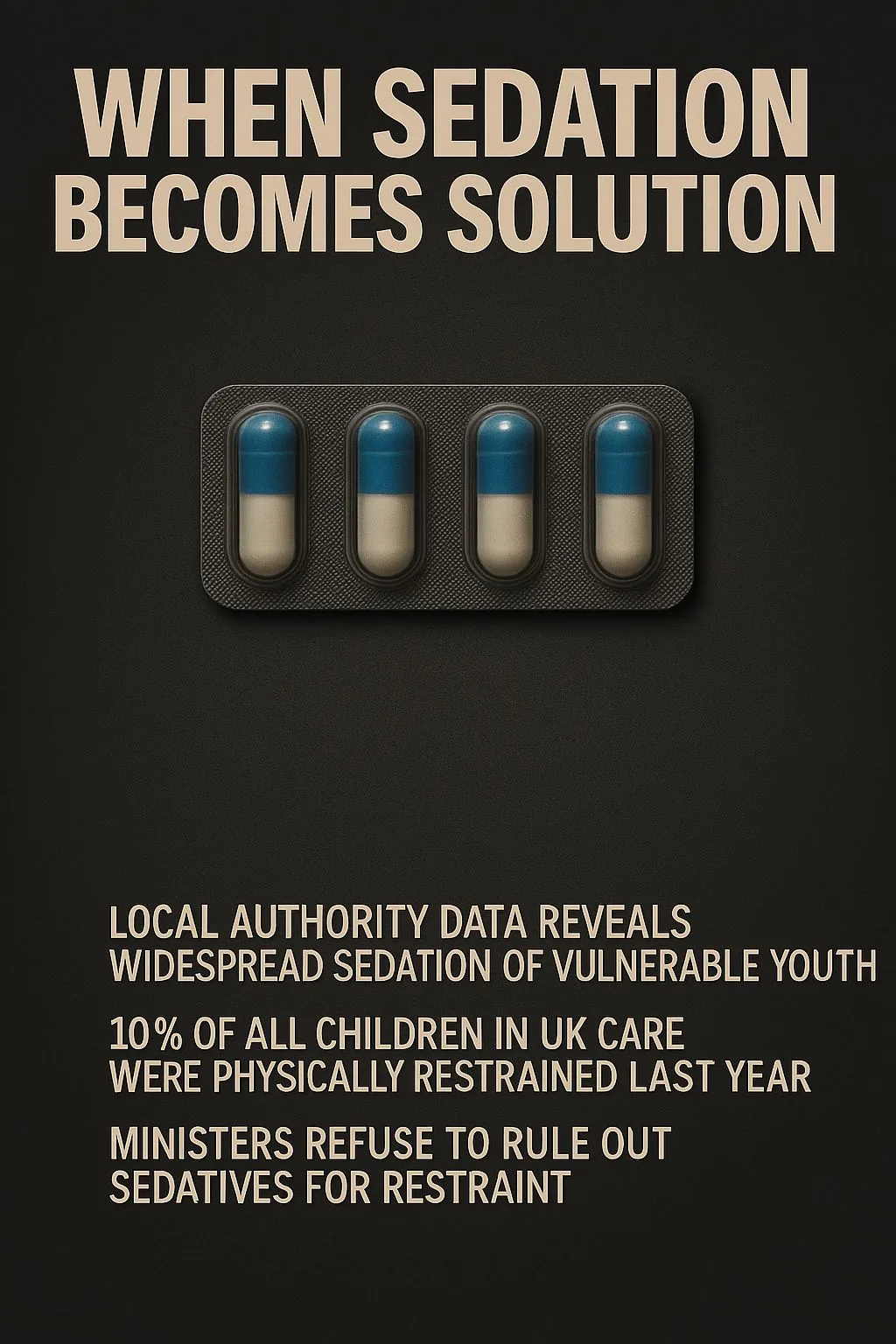
Inside the Welsh care homes using medication to control children — and the system that let it happen
THEY SAID HE WAS “TOO MUCH.” SO THEY SHUT HIM UP.

No diagnosis. No therapy. No trauma support.
Just a prescription. A pill. And a boy who stopped speaking.
In Wales, vulnerable children—many with autism, PTSD or both—are being sedated not for treatment, but for management. Antipsychotics like risperidone. Benzos to knock them out. Given as “behaviour control,” not mental health care.
And it’s happening in homes paid for with public money. Behind the doors of supposedly specialist facilities. While councils look away. While regulators fail to act. And while children disappear into silence—drugged into submission by a system that calls itself “care.”
This is not an isolated incident. It’s a pattern.
And like every pattern this country doesn’t want to face, it’s buried under euphemisms. “Challenging behaviour.” “As-needed medication.” “Crisis protocol.”
But let’s be clear.
This is chemical restraint.
THE PRACTICE: DRUGGING CHILDREN INTO OBEDIENCE

When you hear the phrase “chemical restraint,” think of this:
- A 13-year-old girl with autism given adult antipsychotics because she screams when overstimulated.
- A boy who survived abuse, sedated nightly with no psychologist on file.
- A child left drooling in a wheelchair, monitored only by underpaid staff trained in restraint—not recovery.
A 2018 Wales-wide study found that children with autism or intellectual disabilities are 20x more likely to be prescribed antipsychotics than their peers. Not for schizophrenia. Not for bipolar. But for behavioural control.
Even NICE guidelines make it clear: antipsychotics should only be used in children when absolutely necessary, after all other supports have failed, and under specialist supervision. Yet FOI sources and internal council reviews show kids being medicated without psychiatric diagnoses, simply because they’re “too difficult” to manage.
And once that first pill is given, it rarely stops at one.
The side effects aren’t a footnote.
Weight gain. Hormonal disruption. Emotional blunting. Tremors.
Increased risk of injury, respiratory illness, and depression.
This isn’t just unethical. It’s violence disguised as protocol.
THE PROVIDERS: PRIVATE CARE, PUBLIC CASH, AND ZERO ACCOUNTABILITY

Follow the money. You’ll find the motive.
In Wales, 87% of children’s residential care is in private hands. Big names like Orbis, Cambian, CareTech, Keys Group—companies raking in hundreds of millions from council contracts while calling themselves “specialist providers.”
But “specialist” doesn’t mean safe.
Take Orbis Education and Care. Their Cardiff home, Tŷ Coryton, was hailed as a haven for children with complex needs. Behind closed doors?
- Teenagers locked away for menstruating.
- Restraints used as punishment.
- Whistleblowers silenced.
And where there’s restraint? There’s sedation.
Care Inspectorate Wales flagged one Orbis home for lacking medication oversight completely. No logs. No reviews. No evidence anyone was checking whether kids were being drugged for behaviour, not treatment.
Yet Orbis kept getting placements. Kept collecting contracts. Kept operating unchecked.
Because that’s the real game here: a broken market where private providers cut staff, skip reviews, and reach for pills. Because it’s faster. Because it’s cheaper. Because it’s profitable.
THE COVER-UP: COUNCILS, CIW, AND THE CULTURE OF COMPLIANCE
This isn’t just about the homes. It’s about who let them operate.
Local councils placed these children. They signed off on care plans. They funded the beds. And in far too many cases, they ignored the signs.
One autistic boy was hospitalised after a medication-induced seizure. His mother had been begging the council to review his dosage for months. They only acted when he nearly died.
Care Inspectorate Wales—the official watchdog—has inspection frameworks. But those rely on paperwork, not probing. Homes self-report. Staff records are cherry-picked. And unless someone blows the whistle, sedation gets swept under the rug.
FOI requests to councils asking how many looked-after children are prescribed antipsychotics?
Blocked.
“Not held in a disaggregated way.”
“Would require disproportionate effort.”
Translation: they don’t want you to know.
Even the Children’s Commissioner for Wales admitted there is no public audit of sedative use in children’s homes. No central oversight. No accountability.
And so the system turns, quietly. Dosing children in silence.
Not for healing. For compliance.
SOURCES & RECEIPTS
1. Care Inspectorate Wales (CIW) Reports & FOI Responses
- CIW Inspection Reports:
- FOI Requests on Medication Reporting:
2. Antipsychotic Prescribing Guidelines & Protocols
- All Wales Protocol for Antipsychotic Prescribing:
- Reducing Restrictive Practices Framework:
3. Senedd Reports & Debates
- Use of Antipsychotic Medication in Care Homes Report:
- Senedd Debate on Antipsychotic Prescribing:
4. Academic Studies & Data Analyses
- Characteristics of Children Prescribed Antipsychotics:
- Antipsychotic Prescribing Trends in Youth with Autism Spectrum Disorder:
5. Whistleblower Protections & Reports
- Children’s Commissioner for Wales on Whistleblowing:
- Report on Safeguards for Children in NHS Wales:
6. Regulatory Frameworks & Policies
- Regulation and Inspection of Social Care (Wales) Act 2016:
- Code of Practice for Inspection of Regulated Services: