NEURODIVERSITY & ADDICTION: THE REGULATION NOBODY TALKS ABOUT
©️ Sophie Lewis|Shadowborn
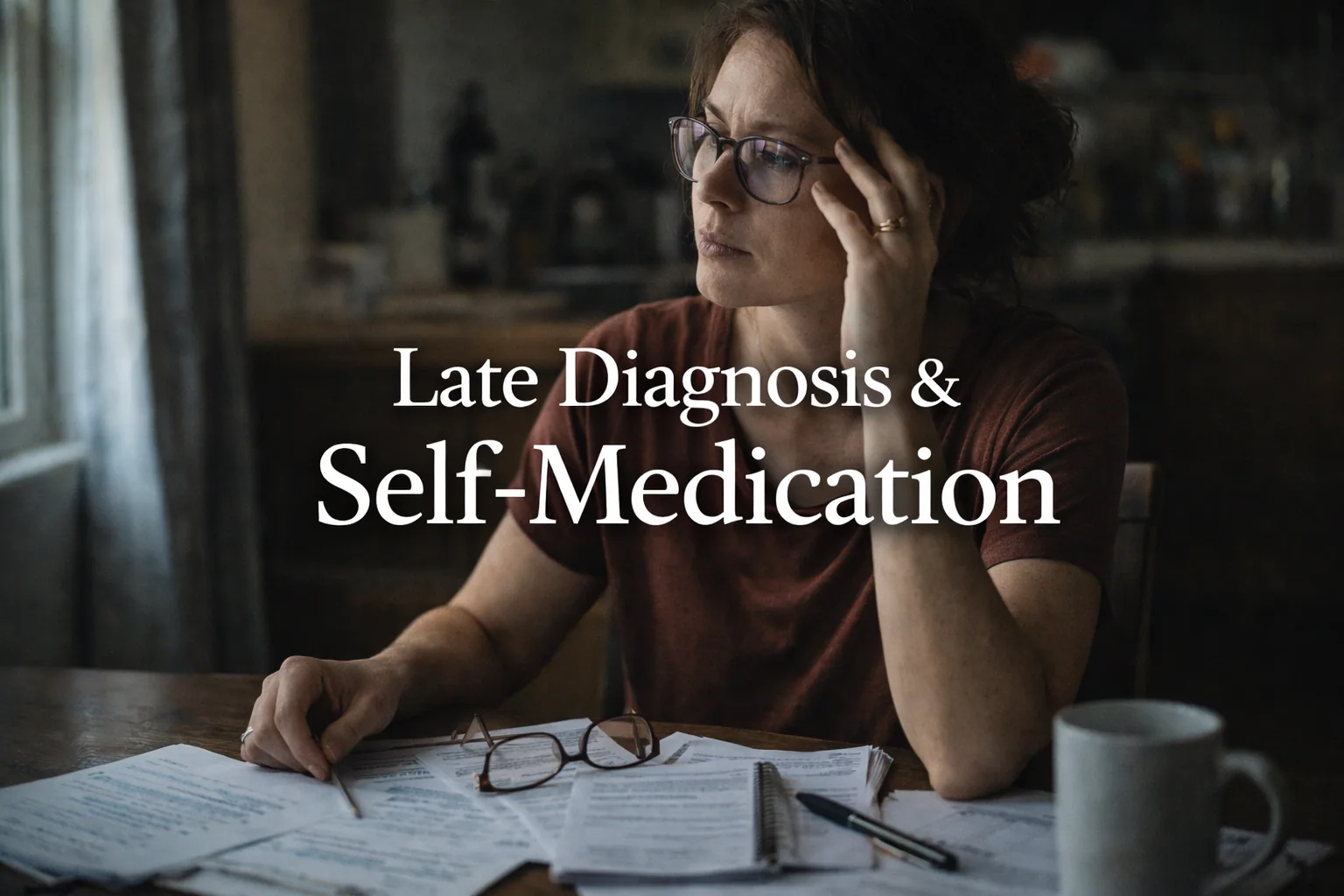
Part 4 – Late Diagnosis & Self-Medication
A lot of adults weren’t failing at life. They were managing a brain nobody had bothered to understand yet.
There is an entire generation of people who were never told.
Not because the information didn’t exist. Not because the signs weren’t there. But because the systems designed to identify and support neurodivergent people were built too narrow, too late, too focused on a very specific presentation, usually a hyperactive boy who couldn’t sit still in a classroom, to catch everyone else.
The girls who went quiet instead of loud. The children who were bright enough to compensate, to mask, to perform adequacy so convincingly that nobody looked underneath. The ones whose chaos was internal rather than external, whose struggle lived inside them, invisible and unnamed, while they smiled and tried harder and wondered privately why everything that seemed effortless for other people required such enormous, exhausting effort from them.
Those people grew up. And they took their undiagnosed nervous systems with them into adulthood. Into relationships and careers and parenthood and all the complex, demanding territory of a life, with none of the understanding or tools they should have had, and all of the shame that accumulates when you spend decades not knowing why you are the way you are.
Here is what happens to a nervous system in that situation.
It adapts. It improvises. It finds, through years of trial and error, the things that make it possible to function, to meet deadlines, to get through social situations, to quiet the noise long enough to sleep, to feel something other than the grey static of chronic under-stimulation.
Some of those adaptations are invisible. Rigid routines. Obsessive research. Over-preparation as a defence against the chaos of an unpredictable mind. Hyper-independence because depending on others has never felt safe when you can’t predict your own reliability.
And some of them are substances.
Not always dramatically. Not always in ways that look, from the outside, like a problem. A drink to take the edge off social anxiety. Cannabis to quiet the relentless mental noise at the end of the day. Stimulants, prescribed or otherwise, that make the brain do the thing it cannot seem to do on its own. Anything that closes the gap between how the nervous system feels and how it needs to feel to get through the day.
This is self-medication. And it is, in the most literal sense, exactly what it sounds like. It is a person treating a condition they didn’t know they had, with tools they found themselves, because nobody gave them anything better.
The late diagnosis, when it finally comes, is a strange and complicated thing.
For many people it arrives as relief first. The pieces clicking into place. The sudden, vertiginous recognition that there was always a reason, that the struggle wasn’t character failure or laziness or some inexplicable personal deficiency, but neurology. Real, nameable, not their fault.
That relief is legitimate and it deserves to be felt fully.
But underneath it, often arriving quietly a little later, is something harder.
Grief.
Grief for the years spent not knowing. For the shame carried unnecessarily. For the relationships damaged and opportunities missed and potential unrealised while the brain was running without the understanding or support it needed. For the younger self who tried so hard, in all the wrong directions, because nobody had given them the map.
And grief, specifically, for the self-medication. Because the late diagnosis doesn’t just explain the struggle, it recontextualises everything that came after it. Every substance, every behaviour, every coping mechanism that became a problem, it all looks different now. Not as evidence of weakness or moral failure or being fundamentally the kind of person things go wrong for. But as a logical, human, entirely understandable response to an impossible situation.
You were not broken. You were unequipped. And you did what unequipped people do, you found tools. The tools had costs. You didn’t know that when you picked them up, because you didn’t know what you were building, because nobody told you what you were working with.
That recontextualisation is not an excuse. It doesn’t erase the consequences or the damage done. But it matters. It matters enormously. Because you cannot begin to make genuinely different choices until you understand why you made the ones you did, and understanding requires compassion, not contempt.
There is also something that doesn’t get said enough about the self-medication years.
They weren’t only destruction.
For many people, the substances or behaviours they used to regulate themselves were also the things that made their gifts accessible. The cannabis that quieted the noise enough to think creatively. The alcohol that lowered the social threshold enough to connect. The chaos that activated the hyperfocus that produced the best work they’d ever done. The intensity of a volatile relationship that made them feel, finally, fully alive.
This is not a justification for continuing. It’s an acknowledgement of why stopping is so much more complex than it looks from the outside. When you remove the thing that was regulating you, you don’t just lose the problem. You lose the function. You lose the access to parts of yourself the regulation was enabling.
Which means recovery, for the late-diagnosed person, isn’t just about removing a behaviour. It’s about finding new ways to access what the behaviour was providing, the creativity, the connection, the aliveness, the quiet. Without the cost.
That is a different project entirely from white-knuckling through withdrawal. And it requires a completely different kind of support.
Most people don’t get that support.
They get told to stop. They get told to try harder. They get handed frameworks built for people whose relationship with substances was never neurological in the first place, frameworks that address the behaviour without ever touching the underlying need, which means the underlying need finds something else. Goes somewhere else. Resurfaces in a different form, wearing different clothes, doing the same job.
And the person is left wondering why they keep ending up here. Why the work never seems to hold. Why they can stop the thing but they can’t seem to stop the needing.
The answer is that the needing was never the problem they were being treated for.
If you are reading this and something in it feels uncomfortably familiar, the exhaustion of a life lived without understanding yourself, the substances or behaviours that became load-bearing walls before you realised, the strange grief of finally having a name for something you’ve been carrying alone for years,
You were not failing.
You were managing something unmanaged, navigating something uncharted, surviving something that should have been met with understanding and wasn’t.
That is not nothing.
That is, in fact, extraordinary.
And it is not too late for the understanding to arrive, even if it’s arriving now, even if it’s arriving here, even if it’s decades later than it should have been.
Part 5: Neurodiversity Beyond ADHD, coming next.