NEURODIVERSITY & ADDICTION: THE REGULATION NOBODY TALKS ABOUT
©️ Sophie Lewis|Shadowborn
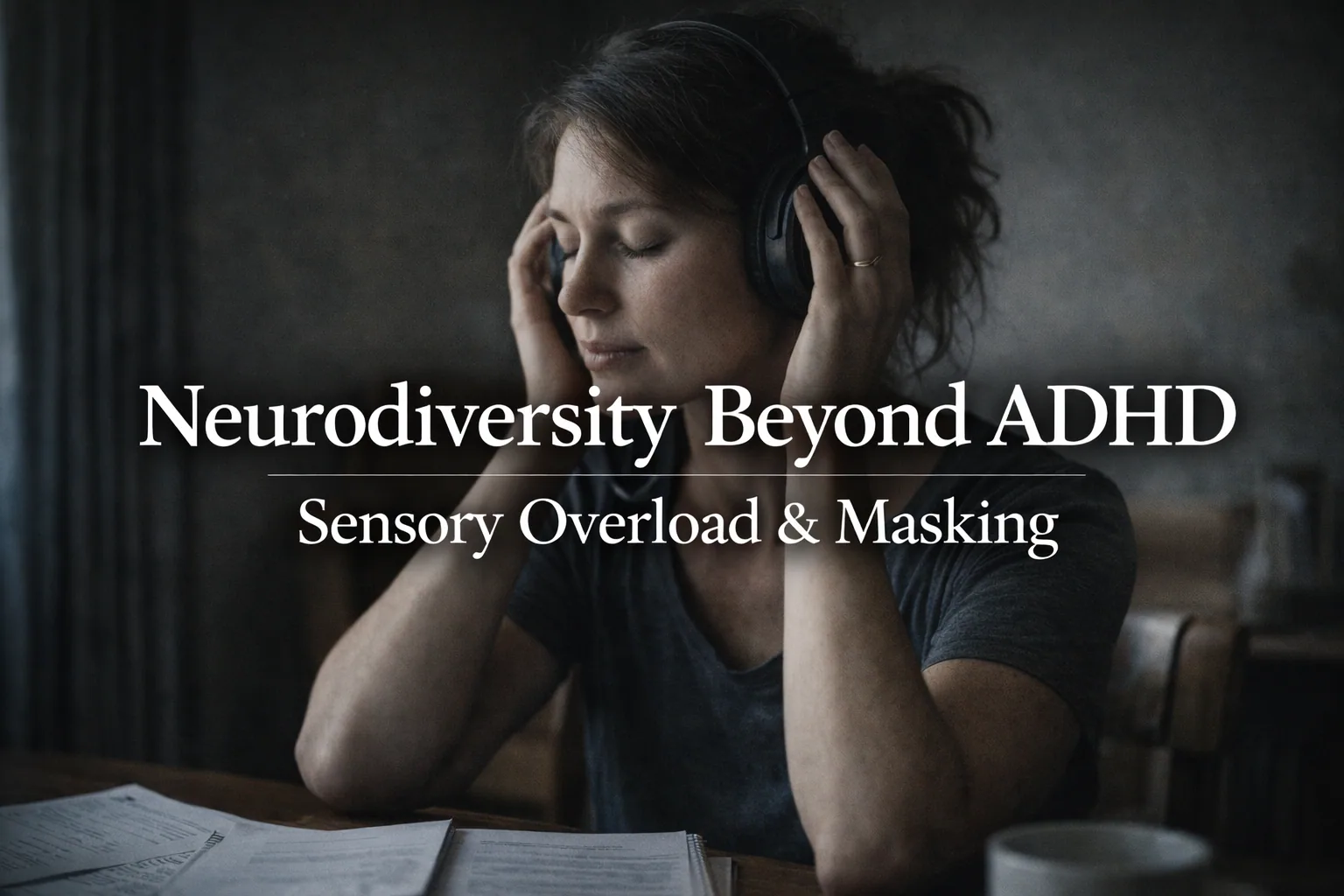
Part 5 – Neurodiversity Beyond ADHD
Masking is a full-time job. Eventually, something has to pay for the overtime.
Most of this conversation, when it happens at all, happens around ADHD.
And that matters. The ADHD and addiction connection is real and significant and chronically under-discussed, and Parts 1 through 4 of this series have tried to give it the examination it deserves.
But ADHD is not the whole picture.
Neurodiversity is not one thing. It is a broad, complex, deeply varied landscape of nervous systems that process the world differently, and the relationship between that difference and addiction is not limited to one diagnosis, one presentation, one story.
This piece is about widening the lens. About the people who didn’t see themselves in the ADHD conversation but who might find themselves here.
Let’s talk about autism.
Autism and addiction have a relationship that is profoundly under-researched, significantly misunderstood, and almost entirely absent from mainstream conversations about either. The prevailing cultural image of autism, still, despite everything, skews heavily toward a particular presentation that excludes a significant proportion of autistic people, particularly women, girls, and people who learned early to hide.
Those people learned to mask.
Masking is the process of suppressing, camouflaging, or performing over your natural neurological responses in order to appear neurotypical. It involves monitoring every micro-expression, calibrating every social response, translating the implicit social language that neurotypical people absorb unconsciously into a set of rules that have to be consciously applied, every single time, in every single interaction.
It is exhausting in a way that is almost impossible to communicate to someone who has never had to do it. Not the tiredness of a long day. The tiredness of running a background programme at full capacity for every waking hour, a programme that takes up cognitive and emotional resources that were supposed to be available for everything else.
And it works. That’s the cruel part. It works well enough that the people around you have no idea. Which means you get no accommodation, no understanding, no reduction in demand. You just keep running the programme, and nobody notices the cost, because the whole point of the programme is that nobody notices.
Eventually, the programme crashes.
Autistic burnout is not the same as ordinary exhaustion. It is a profound, sometimes months-long shutdown of the nervous system, a collapse of the capacity to mask, to function, to engage with the world at the level previously maintained. It can look like depression. It can look like regression. It can involve losing access to language, to social function, to the basic activities of daily life.
And in the lead-up to burnout, in the relentless accumulation of masking hours and sensory overload and social translation and the particular grief of never quite being able to just exist without performance, the nervous system is desperately looking for relief.
This is where substances enter for many autistic people. Not as recreation. Not as social lubricant, though alcohol in particular gets used that way because it chemically lowers the threshold for the social performance masking requires. But as genuine, urgent regulation. As a way of turning down the volume on a world that is constantly, aggressively, overwhelmingly loud.
Sensory processing is central to this and it’s a dimension of the addiction conversation that almost never gets included.
For many neurodivergent people, autistic people particularly, but not exclusively, the sensory environment is not neutral background. It is constant input that requires constant processing. Light that is too bright. Sound that arrives at the wrong frequency, or too many frequencies at once. Textures, temperatures, smells that the nervous system cannot file away as irrelevant because it has no efficient mechanism for doing so.
The cumulative effect of a day spent in ordinary sensory environments, offices, supermarkets, public transport, social gatherings, can be genuinely depleting in a way that has a direct physiological basis. The nervous system has been working, hard, all day, on something that the people around you weren’t even aware of doing.
Substances that dull sensory sensitivity, alcohol, cannabis, opiates, provide something that is, for this nervous system, closer to relief from physical pain than to recreational pleasure. The quieting is not indulgence. It is the first moment all day that the input has been manageable.
Understanding that changes the conversation about why the dependency develops. And why telling someone to simply stop, without addressing what the stopping removes, so frequently fails.
There is also the dimension of intense interests and what happens when they tip.
Many autistic people experience their areas of deep interest not as hobbies but as something closer to a neurological necessity, a source of regulation, identity, and genuine joy that functions differently from casual preference. The depth of engagement, the completeness of absorption, the way the interest can provide relief from an overwhelming world by offering a space of total competency and control.
This capacity for intensity is not a problem in itself. In many cases it’s a profound gift, the engine behind extraordinary expertise, creativity, and contribution.
But it is also the same capacity that, when it latches onto a substance or a behaviour, produces dependency with a speed and completeness that can be bewildering. The same neurological depth that makes an autistic person the world’s foremost expert on something they love can make them, with equal efficiency, entirely consumed by something destructive.
The intensity doesn’t change. Only the object of it does.
And then there is the layer that sits underneath all of this, for autistic people and for many other neurodivergent people too.
The layer of having spent a lifetime being fundamentally, structurally misunderstood.
Not occasionally. Not in isolated incidents that can be processed and moved on from. But persistently. Systemically. In ways that accumulate into a particular kind of loneliness that is hard to name, the loneliness not of being alone but of being consistently, exhaustingly untranslatable. Of communicating clearly, from your perspective, and being heard as something entirely different. Of trying to connect and finding that the connection keeps landing slightly wrong, through no fault you can identify or correct.
That loneliness is its own wound. And it drives its own reaching.
The substance or behaviour that makes social connection feel possible, or that makes the loneliness bearable, or that creates a temporary sense of belonging, in an online community, in a subculture, in the particular camaraderie that can exist among people who use the same things, is not simply a bad choice. It is a human being trying to solve a human problem with the tools available to them.
This series has focused heavily on ADHD because that’s where the research and the public conversation are most developed. But the principles underneath it, chronic nervous system dysregulation, the logical search for relief, the shame and misunderstanding that compound the original wound, apply across the neurodivergent spectrum.
They apply to the autistic person who drinks to get through the work Christmas party and doesn’t know how to stop once they’ve started.
They apply to the dyspraxic person whose relationship with their own body is so fraught that substances become the only reliable way to feel at home in it.
They apply to the person with sensory processing differences who has built their entire daily routine around the things that turn the volume down enough to function.
They apply, in different configurations and with different specifics, to any nervous system that has been trying to exist in a world not built for it, and has found, along the way, the things that make that possible.
The conversation has been too narrow for too long.
These are the people it was always also about.
Part 6: Regulation Without Destruction, coming next.