Childhood: A Moving Target
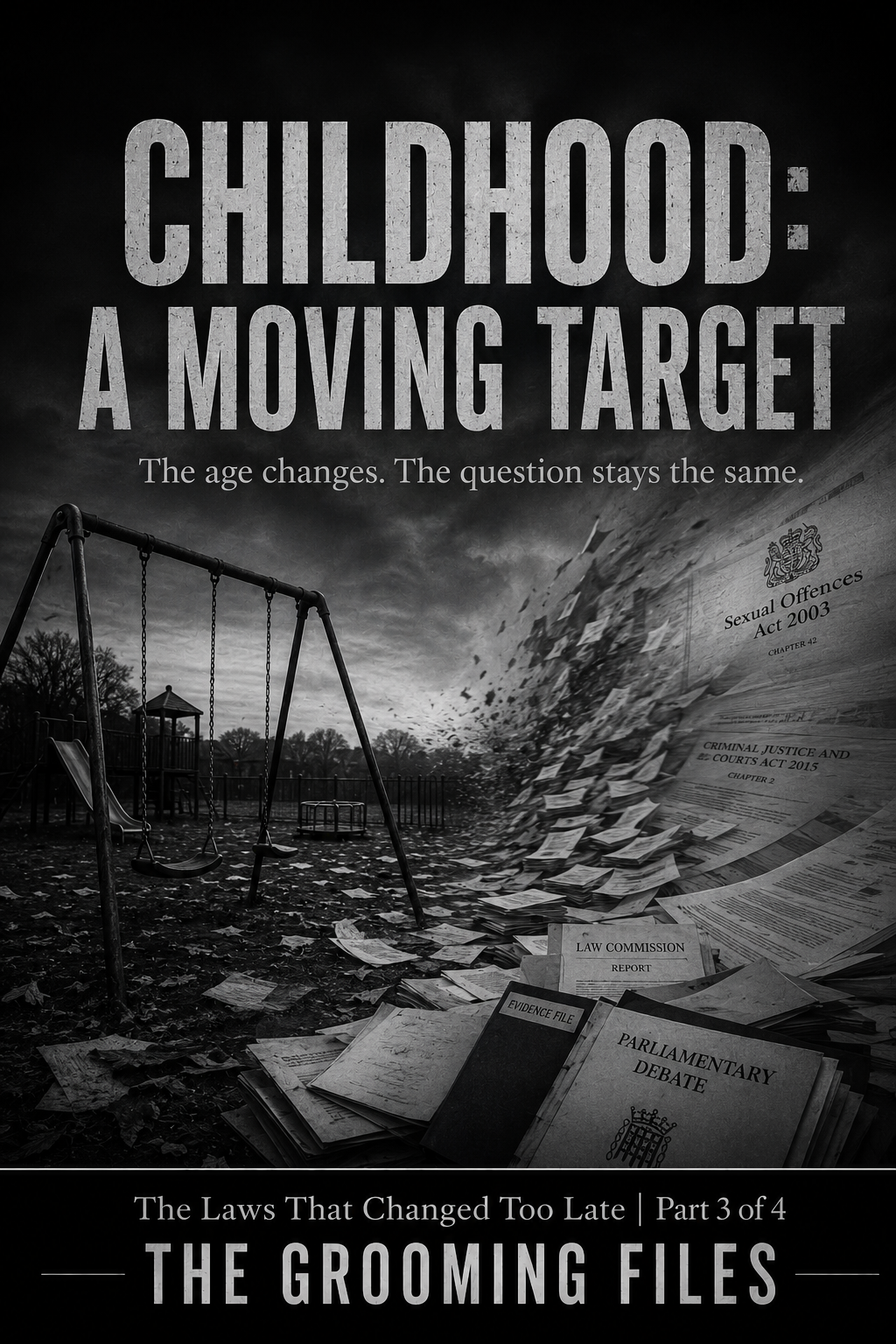
By Sophie Lewis | The Grooming Files
In 1885, Britain decided 13 was too young for sex.
In 2026, we’re debating whether 14 is too young for Instagram.
Childhood has never had one definition. It has a dozen, scattered across different laws, each one decided by a different generation, for a different reason, often decades apart from the others.
Some of those definitions are about readiness.
When is someone capable of choosing who governs them. What they put in their body. What they post online. Get those wrong and a young person waits a bit longer for something they’ll get anyway.
Others are about protection.
When is someone capable of consenting to sex. When are they treated as a child by the law that’s meant to keep them safe from adults. Get those wrong and the gap isn’t an inconvenience. It’s where harm happens.
This piece isn’t an argument for changing any of those ages.
It’s about a pattern that holds across all of them.
Society moves slowly to redefine childhood, no matter which kind of childhood is being redefined. And it moves at the same slow pace whether the cost of being wrong is a teenager waiting two years to vote, or a child left unprotected inside a gap the law hasn’t closed yet.
Look at the thresholds we’ve set. And the dates we set them.
The age of consent is a protection threshold.
In 1875 it was 13.
In 1885, after the journalist W.T. Stead exposed how easily children were being sold in Victorian London, Parliament raised it to 16, where it has stayed ever since.
Read that sequence again. The behaviour Stead exposed wasn’t new in 1885. Children had been bought and used for years. What changed was that someone forced the country to look at it, and the law followed. It took a public scandal to move a number that should never have been 13 in the first place.
The harm came first. The recognition came after. That is the shape of almost everything on this list.
The marriage age is also a protection threshold, and it moved within living memory.
For decades, 16- and 17-year-olds in England and Wales could marry with parental consent.
That only changed in February 2023, when the minimum age became 18 with no exceptions.
The reason was safeguarding. Campaigners had spent years showing that the parental consent route was being used to coerce children into marriage. Parents signing the form weren’t always protecting their child. Sometimes they were the ones arranging it.
For years the law treated a 16-year-old’s wedding as a private family matter. The people inside those marriages knew it wasn’t. They said so. The law took until 2023 to agree.
That is the same delay I keep coming back to.
The age of criminal responsibility points the other way.
In England and Wales it is 10. One of the lowest in Europe.
This is still a protection threshold, but here the child needs protecting from the system rather than from an adult. A 10-year-old can be held criminally responsible here years before they can be in most comparable countries, where the figure is 12, 14, or higher.
We have moved fast to protect children in some contexts and stood completely still in others. The inconsistency rarely gets examined, because the children it affects are not the children we find it comfortable to defend.
Then come the readiness thresholds. And they tell a different story.
The smoking age was 16 until 2007, when it rose to 18.
In April 2026 it changed again. The Tobacco and Vapes Act became law, and from January 2027 the age of sale rises by one year every year, so that no one born on or after 1 January 2009 will ever legally be sold tobacco.
It took the best part of two decades of evidence on addiction and harm to get there. But notice what didn’t happen while we waited. No child was damaged by the delay in raising the smoking age, because the delay just meant the law arrived later, not that anyone was exposed in the meantime.
The voting age is moving as I write this.
For most UK elections it has been 18. Scotland and Wales lowered it to 16 for their own elections years ago.
In February 2026 the government introduced legislation to extend votes at 16 to all UK elections, with the registration age dropping to 14. It is still passing through Parliament.
The argument against it is the same one used against every shift in this list. Are they old enough. Are they ready.
That question, are they ready, is the one we ask about readiness thresholds.
We rarely apply it to protection thresholds, because the stakes are different. Nobody is harmed while we decide whether a 16-year-old can vote. The teenager waits, the law catches up, and the wait costs nothing.
Now look at where those two categories collide.
Social media.
Age limits on social platforms have always been weak. Most set 13 as the minimum, a figure that comes from American data-protection law, not from any assessment of when a child is safe online.
For years that 13 was treated as a readiness question. When is a child old enough to have an account.
That is the wrong question.
And we are only now starting to ask the right one. Not when is a child ready, but what are they being exposed to, and who is reaching them.
Australia has already legislated to bar under-16s from social media. Britain is debating whether to follow.
The framing is shifting from readiness to protection in real time. And it is shifting because the harm became impossible to ignore, not because the law saw it coming.
That is the pattern.
Readiness thresholds move slowly and nobody gets hurt in the waiting.
Protection thresholds move slowly and somebody already has been.
The age of consent moved after a scandal. The marriage age moved after years of documented coercion. The framing on social media is moving now, after a generation of children grew up inside a harm the law hadn’t named yet.
Every one of these numbers was eventually changed by people who could see the problem before the law would admit it existed.
The next question isn’t historical.
It’s which threshold we’re failing to redraw right now, while someone is already inside the gap.
Next in this series: What Are We Missing Right Now?
Follow The Grooming Files for daily public safety reporting, court cases and investigations from across the UK.