The Internet Got There First
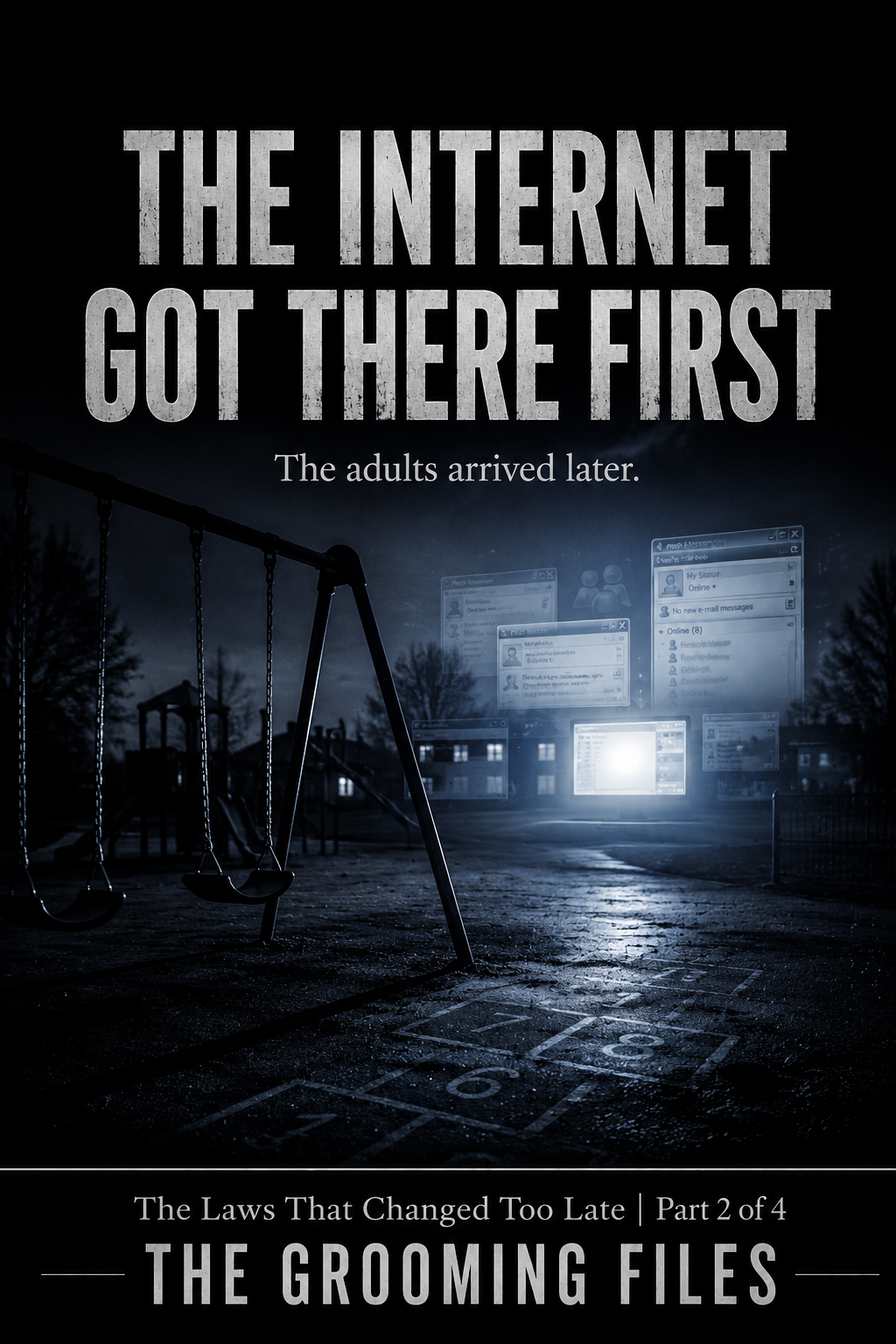
By Sophie Lewis | The Grooming Files
The internet arrived before the adults did.
That’s the simplest way I can explain it.
Long before governments debated online safety. Long before safeguarding policies. Long before schools delivered assemblies on digital risks. Long before parents understood what was happening behind bedroom doors.
The internet was already there.
And so were the predators.
For my generation, the internet wasn’t something we stepped into carefully.
We grew up inside it.
MSN Messenger, Yahoo Chat, AOL, MySpace, Bebo, Habbo. Chatrooms, forums, profile pages, private messages, webcams. We were the first generation handed a global communications network and told to have fun.
Nobody really understood what it would become. Certainly not the adults.
The internet felt exciting. Free. Limitless.
You could speak to people anywhere in the world, make friends, build an identity, escape boredom, find communities, discover things your local town could never offer.
For many young people, it was liberating.
For predators, it was revolutionary.
For the first time in human history, an adult no longer needed physical access to a child. They didn’t need to live nearby, know the family, coach a football team or volunteer at a youth club. They could simply log in.
And children were already waiting.
The danger wasn’t hidden.
We just didn’t recognise it yet.
Looking back now, it’s astonishing how unprepared society was. Children were creating accounts with fake ages, talking to strangers, sharing personal information, sending photographs, meeting people they had only ever known through a screen. And all of it was happening faster than institutions could react.
The law moved slowly. Technology moved quickly. Children sat in the middle.
That gap created one of the largest safeguarding blind spots in modern history.
The adults thought they were supervising a playground. What had actually appeared was an entirely new environment with entirely new risks.
Many of us experienced things online that would trigger immediate safeguarding concerns today. Adults steered conversations towards sex. They asked children for photographs. They manipulated, tested boundaries, isolated children from the people around them, and built the slow, patient kind of relationship that made all of it feel normal.
It was grooming. Almost nobody used that word yet.
That’s one of the strangest parts of looking back. The behaviour existed. The harm existed. The language didn’t.
Many victims didn’t have words for what was happening to them. Many parents didn’t either.
Predators understood the internet before society understood predators online. And they exploited that advantage.
While policymakers debated the future, offenders were already living in it. While schools focused on stranger danger in parks and streets, children were carrying strangers directly into their bedrooms through computer screens.
The rules had changed. The adults hadn’t noticed.
Eventually, the law caught up.
The Sexual Offences Act 2003 modernised much of sexual offending legislation and, for the first time, made online grooming a recognised offence. Safeguarding frameworks evolved. Police developed specialist units. Platforms introduced reporting systems.
But by then, countless children had already passed through that gap.
The internet got there first.
And the story isn’t really about technology. It’s about a pattern. A new environment appears, people start being harmed inside it, victims recognise it first, and the law arrives years after the damage is done.
The internet wasn’t unique because this happened. It was unique because it happened at a scale humanity had never seen before. Millions of children entered digital spaces before anyone fully understood the consequences.
And now, twenty years later, we’re having conversations about age verification, social media bans, algorithmic harms, online exploitation and digital safeguarding. Questions that perhaps should have been asked much earlier.
The uncomfortable truth is that technology usually arrives before the protections designed to regulate it.
The internet wasn’t dangerous because it created predators. It was dangerous because it gave them access, anonymity and opportunity on a scale that had never existed before.
Children entered that world long before society understood what it was. Many of us were learning the risks in real time.
Some of us paid for that education.
Today, politicians, researchers, parents and safeguarding professionals continue debating how to protect children online. Those conversations matter. But they should also remind us of something.
The internet got there first.
And history suggests whatever comes next probably will too.
Next in this series: Childhood: A Moving Target
Follow The Grooming Files for daily public safety reporting, court cases and investigations from across the UK.