What Are We Missing Right Now?
By Sophie Lewis | The Grooming Files
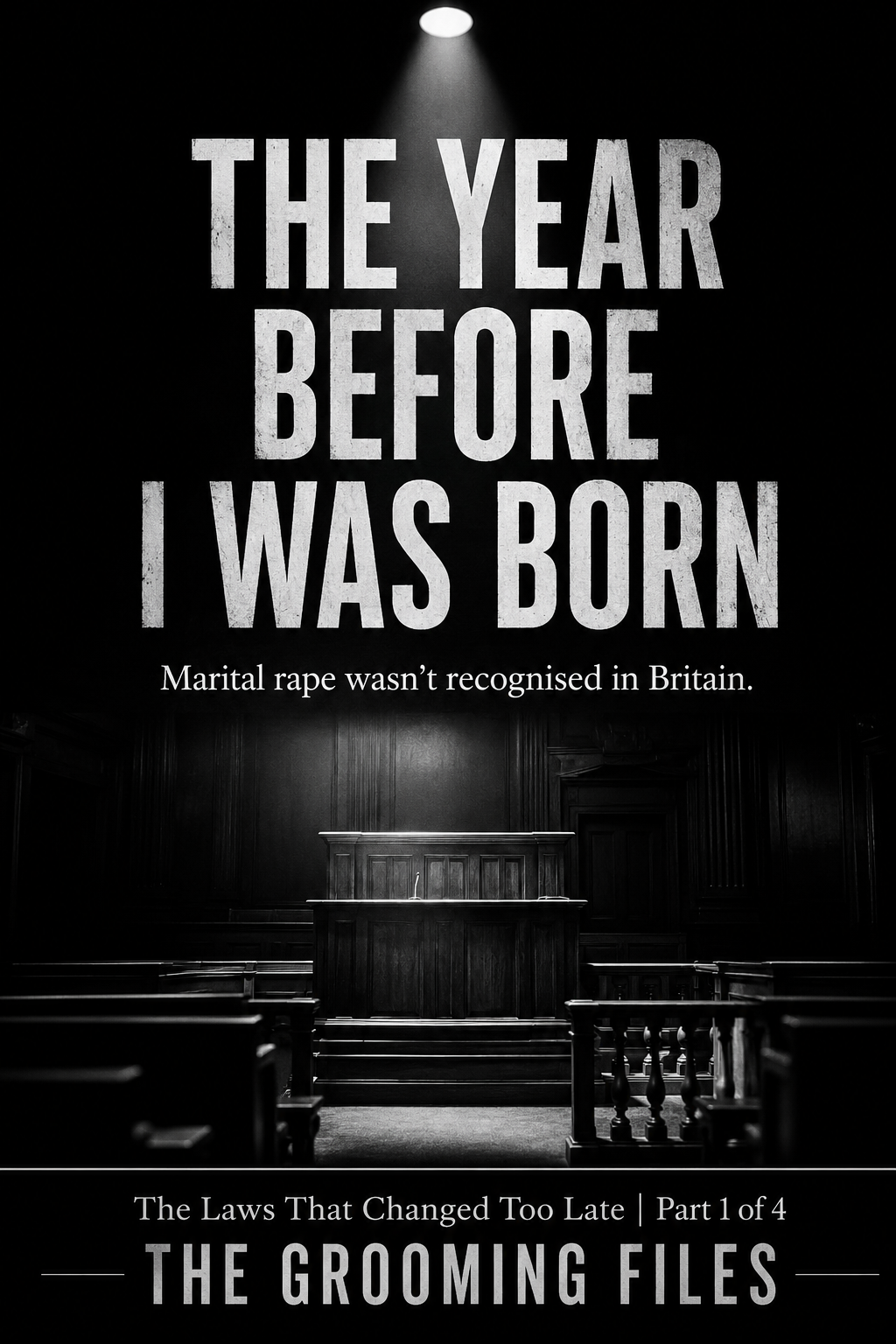
The year before I was born, marital rape wasn’t recognised in Britain.
Today, that feels unthinkable.
Most people react the same way when they hear it. Shock, disbelief, and the same confused question: how could something so obvious have taken so long?
But history asks a far more uncomfortable question than that.
What are we missing right now?
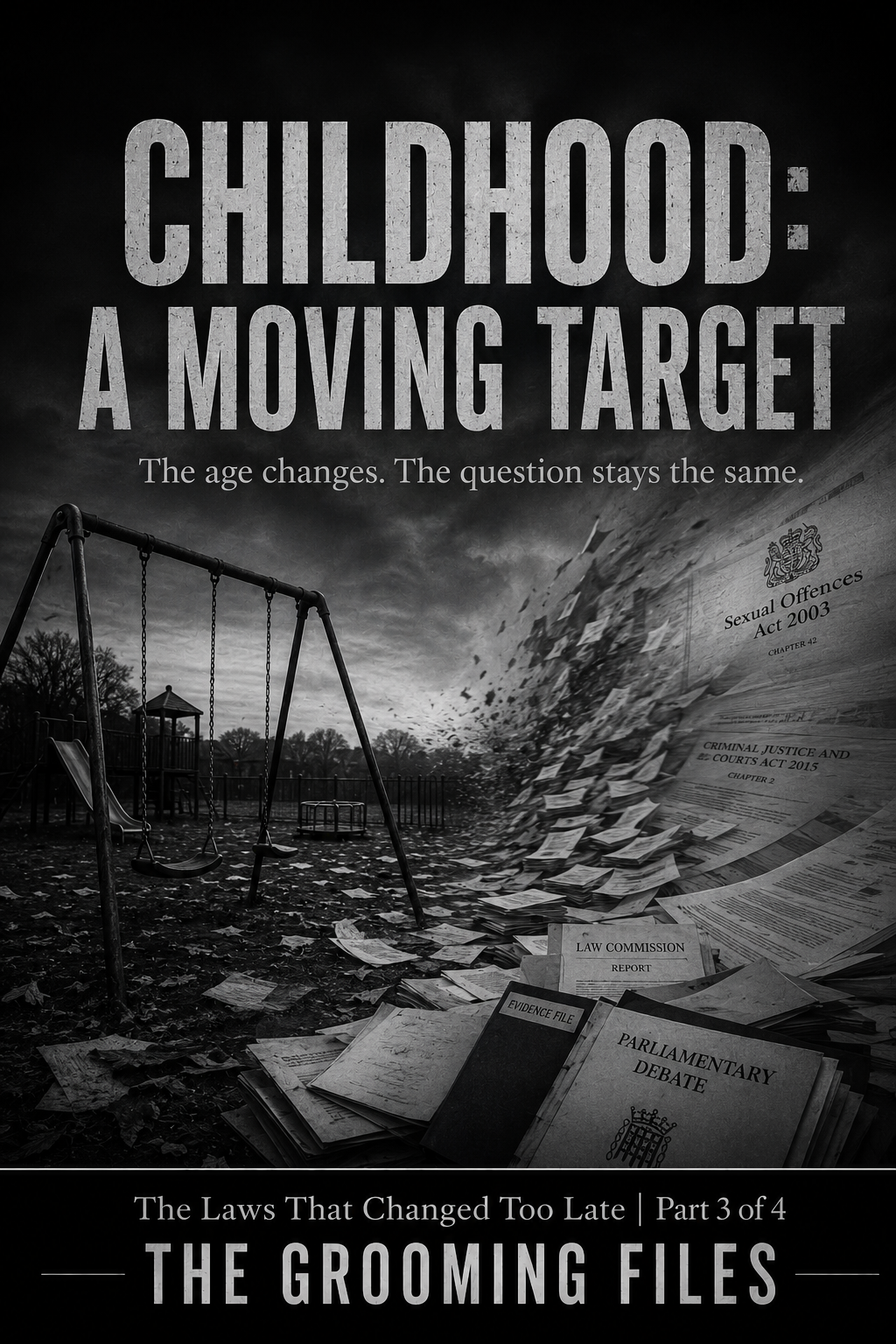
Because every generation looks back at the mistakes of the previous one and assumes it would have seen things differently. We imagine we would have recognised the warning signs, listened to the victims, asked the difficult questions and demanded change sooner.
History suggests otherwise.
Most harms are not hidden. They’re visible. People simply disagree about them until the evidence becomes impossible to ignore.
Women knew marital rape existed long before 1991.
Children knew grooming existed long before it became a national conversation.
Victims of child sexual exploitation knew exactly what was happening while institutions argued over definitions, thresholds and procedures.
The pattern repeats over and over again.
Not because nobody knows. Because not enough people listen.
It would be easy to take this too far. Not every alarm society raises turns out to be real. There are panics that burn brightly and fade, harms that were never as large as the fear that surrounded them. Recognising a genuine blind spot is not the same as treating every worry as one. The hard part, and the part that actually matters, is telling them apart.
So what are we missing now?
Maybe it’s pornography.
For many children today, pornography isn’t discovered at eighteen. It isn’t discovered at sixteen. Sometimes it isn’t even discovered at thirteen.
Children are encountering increasingly extreme sexual content during critical stages of development, while society continues to debate whether this is a safeguarding issue, a parenting issue, or simply an unavoidable reality of modern life.
What if future generations view mass childhood exposure to online pornography the same way we now view cigarette advertising aimed at children?
Maybe it’s artificial intelligence.
Children are already forming emotional relationships with machines. AI companions offer validation, affection, emotional support and simulated intimacy, and they do it without judgement, without limits, and without any adult ever knowing.
The technology is developing faster than the regulation. Again.
The question isn’t whether AI will create opportunities for harm. It already has. The question is whether society understands the risks before, rather than after, the damage is done.
And then there’s the one we don’t have to imagine. Because it’s already happening.
Maybe it’s deepfakes.
This isn’t a prediction. It’s the pattern playing out in real time, and we can watch every stage of it.
For years, anyone could use AI tools to generate fake sexual images of a real person. The harm was obvious. Campaigners said so. Survivors said so. And yet, until February 2026, creating a sexually explicit deepfake of an adult was not a criminal offence in Britain.
Sharing one had been illegal since 2023. Making one and keeping it was not.
That gap stayed open until the harm became impossible to ignore. At the start of 2026, an AI tool on X was used to generate sexualised images of women and children on an industrial scale. Around three million of them. The law to criminalise creating these images had been announced a year earlier. It only came into force, under the Data (Use and Access) Act 2025, after the scandal made the delay indefensible.
The same tools are now being used to generate sexual images of real children, and the software that produces them is freely available, with the offence of supplying it only now passing through Parliament.
The behaviour was visible. The harm was documented. Victims spoke. The law arrived late, and only after the damage was done.
Sound familiar?
Maybe it’s algorithmic radicalisation. Maybe it’s a form of online exploitation we haven’t named yet. Maybe it’s something none of us are discussing at all.
That’s the unsettling part.
The next major safeguarding failure rarely announces itself in advance. It emerges quietly.
People notice fragments.
Victims raise concerns.
Experts debate.
Institutions hesitate.
Then one day society collectively looks back and wonders why it took so long.
The truth is that progress is rarely a straight line. It is usually a trail of missed warnings. A timeline of people who spoke before anyone was ready to hear them.
That’s why history matters. Not because it lets us congratulate ourselves on how far we’ve come, but because it reminds us how often we’ve been wrong.
The legal recognition of marital rape wasn’t a story about a problem suddenly appearing in 1991. It was a story about a problem finally being recognised. There is a difference, and that difference matters.
Because somewhere in Britain today, there are people experiencing harms that future generations will understand more clearly than we do now.
Some of those people are already speaking.
Some are already being ignored.
The real question isn’t whether society has another blind spot. History suggests it almost certainly does.
The real question is whether we’re willing to find it before another generation has to ask:
“How did nobody see it?”
Because the chances are, somebody already does.
Follow The Grooming Files for daily public safety reporting, court cases and investigations from across the UK.