ADHD, addiction, and the brain that was never broken
©️ Sophie Lewis | Shadowborn 🌑
The Wiring That Wouldn’t Wait
ADHD, addiction, and the brain that was never broken, just desperate...
Here’s something nobody told me when I was seventeen, hoovering lines off a toilet cistern at 3am because I finally, finally felt like I could sit inside my own skin.
Nobody told me my brain was starving.
Not morally failing. Not weak. Not self-destructive for the sake of it.
Starving.
Because it was never just the cocaine.
It was sugar before I knew what a craving was. Weed that made the noise stop. Chocolate. Painkillers. Chaos. People. Intensity. The next thing and the next thing and the next thing. Because the moment I stopped moving, stopped consuming, stopped chasing, the static came back. And the static was unbearable in a way I could not explain to anyone who did not feel it.
This is what ADHD addiction actually looks like. Not always a needle. Not always a line. Sometimes it is gaming that swallows twelve hours without you noticing. The situationship you cannot leave because the highs and lows are the only thing that cut through the grey. The spending. The picking. The doom-scrolling at 4am. The work you cannot put down because the moment you do, you disappear.
It wears a thousand faces. And every single one of them is doing the same thing. Feeding a brain that is structurally, neurologically, chronically low on dopamine.
Not sometimes.
Not in hard patches.
Constantly…
The ADHD brain does not malfunction in the way you were probably told it does. It is not broken. It is running on a deficit so persistent that the system will seek stimulation wherever it can find it, and it will do that long before you are conscious enough to call it a choice.
That is the part nobody says plainly enough. The seeking is not weakness. It is your nervous system doing exactly what nervous systems are designed to do. Find what they need to survive.
The problem is that what it finds first is rarely what serves it best.
Cocaine fixes the dopamine deficit instantly. Completely. With a force so clean and total that the first time it happens, your body goes, oh. There it is. That is what I have been missing.
So does sugar. So does weed. So does the rush of a new person wanting you. The adrenaline of crisis. The hyperfocus that swallows you whole when something finally holds your attention.
That is not weakness. That is recognition.
People with ADHD are two to three times more likely to develop a substance use disorder than the general population. Not because they lack willpower. Because they found, by accident or desperation, the thing that made their neurology work the way everyone else’s seemed to work without effort.
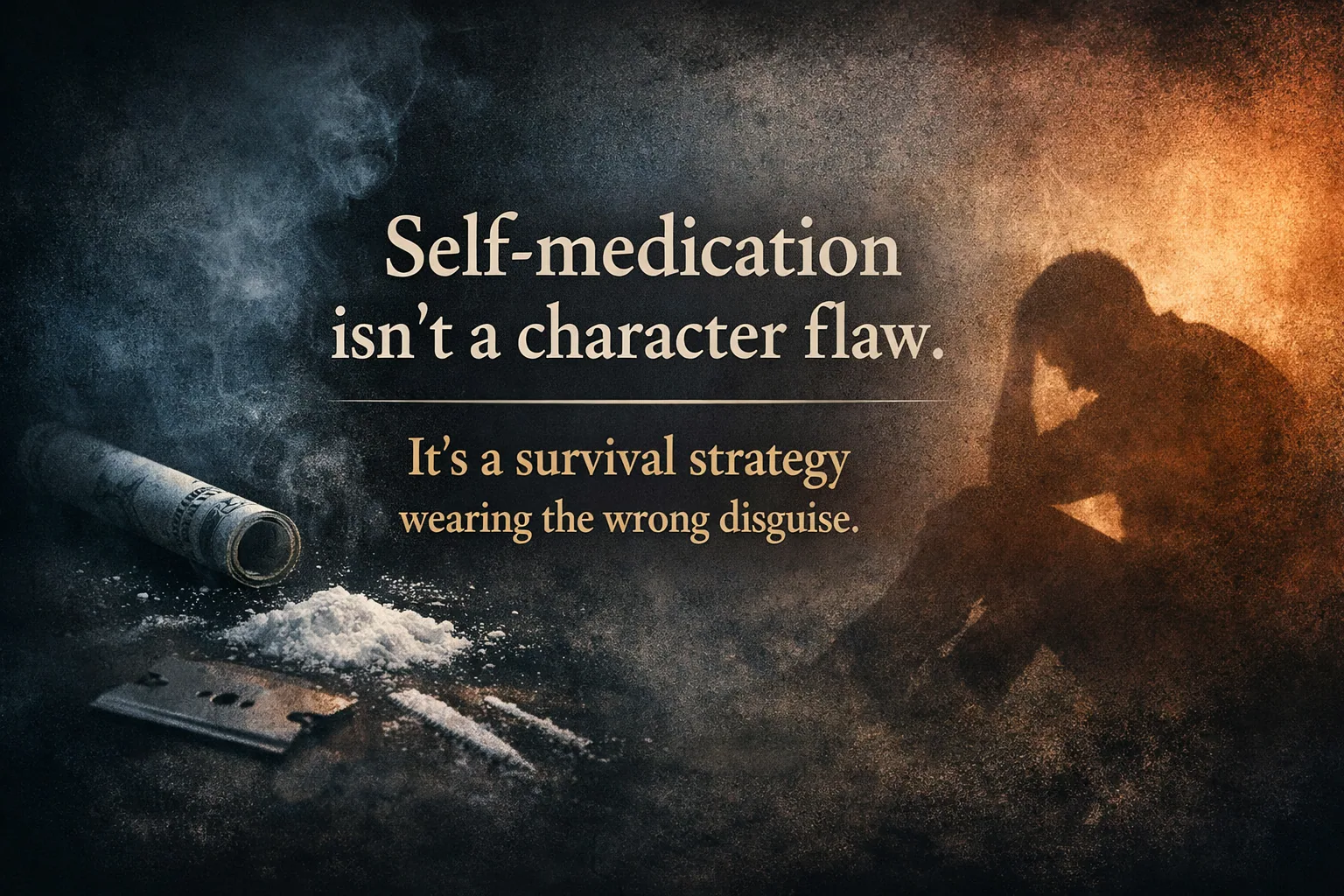
Self-medication is not a character flaw. It is a survival strategy wearing the wrong disguise.
What the Shadow Knows
The part shadow work unlocks, and that clinical language often skirts around, is this.
The addiction was not the original problem.
The addiction was the solution you found before you had better options.
It kept you functional. It quieted the static. It let you finish a thought, hold a conversation, feel something instead of that grey nowhere ADHD brains can slip into. That deserves acknowledgement. Your system adapted. It found relief where it could.
The real question is not why did you use.
It is what was so unbearable that this felt like the most reliable relief available.
And beneath that, what did you believe about yourself that made you think you did not deserve something softer.
Because this is where the shadow really lives. Not in the using. In the shame that follows it.
ADHD already arrives carrying years of criticism. Too much. Not enough. Lazy. Chaotic. Broken. Every system around you was built for brains that are not yours, and you failed those systems publicly, repeatedly, often without understanding why.
So when addiction arrives, whatever form it takes, it does not arrive alone. It arrives as confirmation.
See. You cannot control yourself.
See. You knew it. They knew it. Everyone knew it.
That is the lie that needs unpicking. Slowly. Honestly. Without letting shame steer.
The Integration Piece
Recovery for an ADHD brain is not identical to recovery for a neurotypical one.
Your brain will still chase dopamine after you put the substance down. Or step away from the behaviour. Or delete the app. Or block the person.
The wiring does not vanish.
What changes is how consciously you work with it.
Movement becomes medicine.
Creativity becomes medicine.
Ritual becomes medicine.
This is not mysticism. It is neurochemistry. Novelty. Rhythm. Embodiment. Meaning. These feed a system that has been running on deficit for years.
The shadow work here is learning to need things without shame.
Learning that needing stimulation, needing intensity, needing something that holds your attention is not a moral flaw. It is your neurology asking for regulation.
The question is whether you meet that need in a way that builds you, or in a way that slowly dismantles you.
That is the reckoning.
Not the drugs.
Not the chaos.
Not the list of things you are not proud of.
The belief that you were too broken to deserve anything gentler.
And if we continue to confuse neurological hunger with personal failure, we will keep punishing people for the ways their brains tried to survive.