Grief: The Love That Had Nowhere to Go
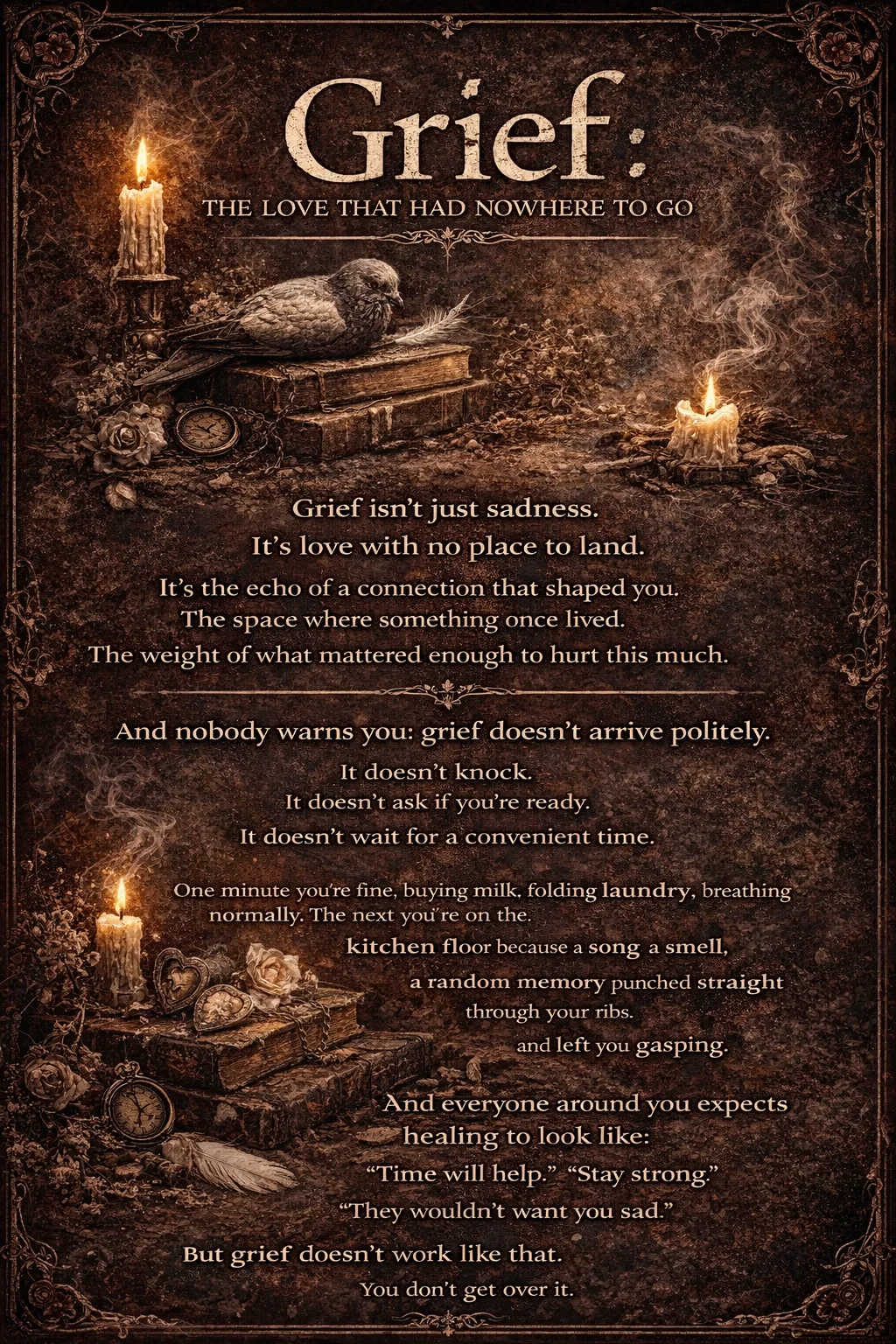

©️ Sophie Lewis|Shadowborn
Grief isn’t just sadness.
It’s love with no place to land.
It’s the echo of a connection that shaped you. The space where something once lived. The weight of what mattered enough to hurt this much.
And nobody warns you: grief doesn’t arrive politely.
It doesn’t knock.
It doesn’t ask if you’re ready.
It doesn’t wait for a convenient time.
It crashes through sideways.
One minute you’re fine, buying milk, folding laundry, breathing normally.
The next you’re on the kitchen floor because a song, a smell, a random memory punched straight through your ribs and left you gasping.
And everyone around you expects healing to look like..
“Time will help.”
“Stay strong.”
“They wouldn’t want you sad.”
“You need to move on.”
But grief doesn’t work like that.
You don’t get over it.
You learn to carry it.
The Lie of Linear Grief
We’re sold a story about grief..
Stage 1: Denial
Stage 2: Anger
Stage 3: Bargaining
Stage 4: Depression
Stage 5: Acceptance
Done. Healed. Moving on.
But real grief doesn’t follow a map.
It spirals.
You can be healed and shattered in the same breath.
Laugh at noon.
Collapse at midnight.
Feel whole on Tuesday.
Destroyed by Wednesday.
You’re not regressing.
You’re revisiting.
Because grief doesn’t live in your mind where you can logic it away.
It lives in your body.
Your muscles remember the shape of their absence.
Your nervous system remembers the way they moved through a room.
Your heart remembers the texture of their presence.
So anniversaries hit.
Random Tuesdays hit.
The smallest things hit, a phrase they used to say, the way light falls on a wall, someone else wearing their perfume.
That’s not weakness.
That’s not being stuck.
That’s love refusing to disappear.
The Griefs Nobody Talks About
Here’s what nobody tells you..
Grief isn’t only death.
We grieve who we used to be before the world broke something in us.
We grieve relationships that ended badly, no closure, just wreckage.
We grieve the childhood we never got, the safety that should have been ours. We grieve versions of ourselves we had to kill to survive. We grieve futures that will never happen now.
We grieve people who are still alive but no longer safe to be near.
We grieve the innocence we lost too early. We grieve the trust that shattered and won’t reform. We grieve the dreams that died quietly.
This grief is quieter.
But it cuts deeper.
Because there’s no funeral.
No flowers.
No permission to mourn.
No ritual.
No one bringing casseroles and asking how you’re holding up.
Just you, alone, grieving something nobody else can see.
So you carry it silently.
You show up to work.
You answer “fine” when people ask.
You function.
And inside, you’re screaming.
When Grief Becomes Loneliness
One of the hardest parts of grief?
It isolates you.
Not because people don’t care.
But because they don’t know how to sit in pain without trying to fix it.
So they change the subject when you mention the loss.
They rush your healing with timelines you never agreed to.
They offer platitudes that feel like paper cuts “everything happens for a reason,” “they’re in a better place,” “at least you had the time you did.”
They get uncomfortable with your tears and suddenly need to leave.
They stop asking after a while because your grief makes them feel helpless.
And you learn the most devastating lesson:
“I’ll hold this myself.”
That’s when grief becomes heavy.
Not because it’s unbearable on its own. But because you’re carrying it alone in a world that’s moved on whilst you’re still standing in the wreckage.
People expect you to be “better” by now. They’re tired of your sadness.
They want the old you back.
But the old you died with what you lost.
And nobody prepared them for that truth.
The Grief That Lives in Your Body
Grief isn’t just emotional.
It’s physical.
Your body holds it: chest tightness that makes breathing feel like work, exhaustion that sleep doesn’t touch, appetite that vanishes or becomes ravenous, tension in your shoulders like you’re bracing for another blow, nausea when memories surface, heart palpitations that make you think something’s medically wrong, immune system crashes, pain in places that make no physical sense.
Your nervous system is in mourning too.
It’s scanning for them.
Listening for them.
Expecting them to walk through the door.
And when they don’t come, your body floods with cortisol, adrenaline, panic, because on some primal level, absence registers as threat.
You’re not broken.
Your body is doing exactly what it’s designed to do when something essential is gone.
It’s continuing to look for what mattered. It’s still oriented towards connection that no longer has an object.
Your autonomic nervous system doesn’t understand abstract concepts like “they’re gone forever.”
It just knows that something critical to your sense of safety and regulation has vanished, and it’s trying desperately to relocate it.
This is why grief exhausts you.
Your body is running a constant background search for something it will never find. It’s why you can sleep for twelve hours and wake up depleted. It’s why small tasks feel monumental.
Your nervous system is burning through resources trying to make sense of an absence that makes no biological sense.
The Shadowborn Truth About Grief
In Shadowborn work, we don’t bypass pain.
We don’t spiritualise it away with “they’re at peace now” or “this is your lesson.”
We kneel with it.
We sit in the ashes.
We let it burn through us.
We honour what it’s teaching.
Because grief strips you bare.
It shows you what actually matters when everything else falls away.
It shows you what you won’t tolerate anymore… the bullshit relationships, the performative living, the pretending. It shows you who you really are when all the masks burn off. It shows you what love looks like when it has nowhere to go but inward.
Grief is an initiation.
Not a pleasant one.
Not one you’d choose.
But sacred nonetheless.
It cracks you open so wide that you either collapse into bitterness or expand into something fiercer, rawer, more alive than you were before.
That’s the Shadowborn path.
Not transcending the darkness.
Not finding the silver lining.
Not making it mean something it doesn’t mean.
But standing in the fire until it transforms you.
Until you realise that the person who walks out of this grief won’t be the person who walked in.
You can’t go back.
The old version of you depended on a reality that no longer exists.
Those assumptions are ash now.
And what grows from ash isn’t the same plant.
It’s something that knows fire.
Something that blooms anyway.
The Rage Inside Grief
Nobody warns you about this part:
Grief isn’t just tears.
It’s rage.
Rage at being left.
Rage at the unfairness.
Rage at unanswered questions.
Rage at how the world keeps spinning when yours stopped.
Rage at people who complain about things you’d kill to have back.
Rage at the randomness of loss.
Rage at yourself.
That doesn’t make you bad.
It makes you human.
Anger is grief’s bodyguard.
It gives shape to powerlessness.
It gives movement to despair.
Let it move through you.
Don’t shame it.
Don’t suppress it.
Don’t perform peace you don’t feel.
The rage is part of the love.
The Guilt of Healing
There comes a moment… weeks, months, years later, when you laugh again.
Really laugh.
And guilt floods in.
Like betrayal.
Like leaving them behind.
But your healing does not erase your love.
Your joy does not dishonour their memory.
You can grieve and live.
You can miss them and still choose yourself.
They are not in your suffering.
They are in your love.
The Sacred Weight of Grief
Grief is heavy.
But it’s sacred weight.
It’s proof you loved deeply enough to lose.
In a world that rewards numbness, staying open is holy.
Grief doesn’t make you weak.
It makes you brave enough to feel everything.
Living With Grief
You don’t do this gracefully.
You do it messily.
You keep going not because you’re strong, but because you’re still here.
And maybe that’s enough.
Not healing.
Not acceptance.
Not moving on.
Just still being here.
Still feeling.
Still loving.
Still choosing life.
The Final Truth
You don’t move on from grief.
You integrate it.
You carry it forward.
You let it reshape you.
And who you become from this fire will be:
fierce
raw
real
Not because grief made you better.
But because it burned away everything false.
What’s left is truth.
What’s left is you.
And that becoming, as devastating as it is.. is sacred.
🖤🕊️