Trauma Bonding: When Pain Feels Like Love
©️ Sophie Lewis| Shadowborn
It doesn’t feel toxic at first.
It feels like coming home.
Like finally being seen.
Like meeting the one person who gets the parts of you everyone else finds too much.
That’s the trap.
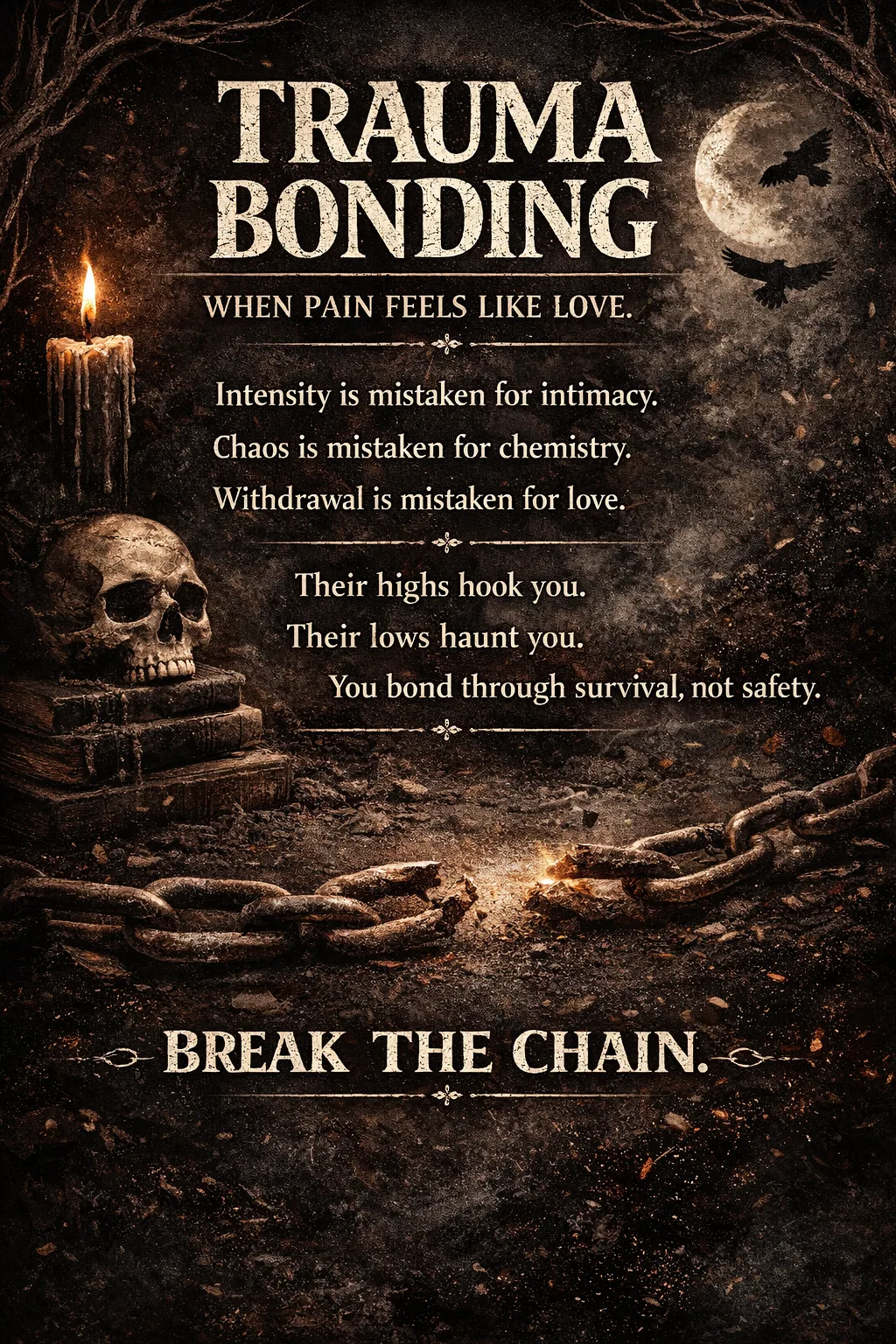
You mistake intensity for intimacy.
Chaos for chemistry.
The adrenaline rush for love.
Because trauma bonds aren’t built in safety.
They’re built in survival.
They form when connection gets tangled with:
unpredictability — you never know which version of them you’ll get
abandonment wounds — the leaving and returning becomes the relationship itself
power imbalance — one person holds all the cards while the other bleeds to earn them
emotional whiplash — highs so high you forget the lows until you’re drowning in them again
Your nervous system gets addicted to the cycle.
Not to them.
To the relief that comes after the rupture.
When someone hurts you, leaves, withdraws, rages at you…
and then comes back?
Your body floods with dopamine.
Relief chemicals.
Attachment hormones.
You don’t feel loved.
You feel hooked.
The Moment of Recognition
There’s a moment when you finally see it.
Not from a book or a therapist.
From your own body, sitting somewhere at 3am, chest heaving, phone in your hand.
You’ve just had another fight.. the kind that shreds your insides and leaves you wondering if you’re the one who’s lost their mind.
The kind where words get said that can’t be unsaid, where accusations carve into bone.
And then they leave.
Just walk out.
No resolution.
No closure.
Just gone.
Your rational mind knows this is wrong. Knows you should feel relief, maybe even anger.
But your body?
Your body goes into full panic.
Heart racing.
Hands shaking.
That desperate, clawing need to fix it, to make them come back, to prove you’re worth staying for.
You pick up your phone.
Type out the message.
The one you’ve sent a hundred times before in different words:
“I’m sorry. Please. Can we talk?”
Your finger hovers over send.
And something snaps.
Not dramatically. Not nobly.
Just… breaks.
You look at yourself… eyes swollen, face wrecked, completely undone and you finally see it:
This isn’t love.
This is withdrawal.
This person isn’t your soulmate.
They’re your drug.
And you’ve been chasing the high of reunion so desperately that you’ve forgotten what peace feels like.
Why Trauma Bonds Feel Stronger Than Real Love
Because they mirror your earliest wounds.
If you learnt love through:
inconsistency — love that came and went like weather
proving your worth — performing to earn affection that should have been free
walking on eggshells — learning to read moods and adjust yourself accordingly
emotional unavailability — begging for scraps of attention from someone who withheld it
abandonment — being left, then welcomed back, then left again
Then stable love feels wrong.
It feels boring.
Suspicious.
Too easy.
Your nervous system says:
Where’s the danger?
Where’s the chase?
Where’s the proof that I’ve earned this?
So you gravitate toward what feels familiar.
Not healthy.
Familiar.
You choose people who make you work for love the same way you had to as a child.
And you call that passion.
The Cycle That Keeps You Trapped
Trauma bonds run on a loop:
Idealisation → you’re everything, the connection is magic, they see your soul
Tension → small cracks appear, something shifts, the safety starts to fracture
Incident → the rupture — betrayal, rage, withdrawal, cruelty
Reconciliation → they return, you’re flooded with relief, they promise it won’t happen again
Calm → brief peace where you convince yourself it’s over, it’s different now
Repeat
Each reunion feels like:
hope restored
redemption earned
proof that you’re lovable after all
But the pattern never changes.
Just the excuses.
“They’re stressed.”
“They had a hard childhood.”
“They’re working on it.”
“This time will be different.”
You don’t stay because you’re weak.
You stay because your nervous system is chemically addicted to the relief phase.
It’s not character.
It’s biology.
The Fantasy You’re Actually in Love With
Here’s the truth nobody wants to hear:
You’re not in love with who they are.
You’re in love with:
their potential — the person they could be if they just healed
their wounded inner child — the part you want to save because nobody saved yours
the version of them that shows up sometimes — the one who’s gentle, present, sees you
the fantasy of finally being enough — if you just love them hard enough, they’ll change
You keep bleeding.
You keep performing.
You keep shrinking yourself.
You keep explaining away the harm.
And you call it devotion.
But devotion doesn’t leave you shattered on bathroom floors at 3am.
Love doesn’t make you question your sanity.
Connection doesn’t require you to lose yourself to keep it.
What Real Love Actually Feels Like
Real love feels:
calm — not boring, but grounded, steady, safe
consistent — you don’t have to earn it daily
boring sometimes — there’s no constant drama to process
spacious — you can breathe, think, exist without performing
clear — you know where you stand without guessing
nourishing — you feel more like yourself, not less
Trauma bonds feel:
all-consuming — they take up every corner of your mind
addictive — you crave them even when they destroy you
chaotic — everything is intense, nothing is stable
suffocating — you lose yourself trying to keep them
confusing — you never know where you stand
depleting — you’re constantly drained, trying to make it work
Intensity is not intimacy.
Chaos is not connection.
Pain is not proof of love.
If you have to constantly fight for someone’s presence, you don’t have their love.
You have their ambivalence.
Breaking the Bond Feels Like Dying
Because it is a kind of death.
When you finally walk away from a trauma bond, you don’t feel liberated.
You feel like you’re drowning.
The first week you might:
check your phone obsessively waiting for the message that would pull you back
romanticise every good moment — your mind edits out the pain and replays the magic
doubt yourself constantly — maybe you were too sensitive, maybe you gave up too easily
feel physically sick — nausea, insomnia, chest pain, the whole withdrawal experience
want to go back — not because you want them, but because the emptiness is unbearable
That doesn’t mean you made the wrong choice.
It means your nervous system is detoxing from an addiction it didn’t know it had.
Healing feels lonely before it feels peaceful.
It feels wrong before it feels right.
You’ll crave them.
You’ll romanticise the past.
You’ll question whether you’re throwing away your only chance at love.
That’s not intuition.
That’s your nervous system in withdrawal, searching for the drug it depended on.
Sit with it.
Don’t run back.
The discomfort is proof you’re healing.
The Questions That Break the Spell
When you’re caught in a trauma bond, ask yourself:
Do I feel safe…
or just familiar?
Am I seen…
or just needed?
Am I growing…
or just surviving?
Do I feel more like myself with them…
or less?
Do I have to perform to keep their love…
or is it just there?
Can I be angry, tired, messy, human…
and still be loved?
If the answers make you uncomfortable, that’s your body telling you the truth your mind doesn’t want to hear.
What Keeps People Going Back
It’s not love.
It’s:
The hope that this time will be different — that if you just love them right, they’ll finally choose you consistently
The fear of being alone — because painful connection feels safer than no connection at all
The validation of being chosen — even inconsistently, even painfully, being chosen feels like proof you matter
The sunk cost fallacy — you’ve invested so much pain, so much time, so much of yourself; leaving feels like waste
The fantasy of healing them — if you could just love them enough, save them enough, they’d become the person you need
None of that is love.
That’s trauma trying to resolve itself through repetition.
Your psyche doesn’t want to heal the person in front of you.
It wants to heal the wound in you that made you believe love should hurt.
The Shadowborn Truth About Breaking Free
Breaking a trauma bond isn’t about hating them.
It’s about choosing yourself.
It’s not about whether they’re bad or good.
It’s about whether the relationship leaves you whole or hollowed.
Some people are good people and still wrong for you.
Some connections are deep and still destructive.
You don’t need to villainise them to leave.
You just need to recognise that staying is killing the version of you that deserves peace.
Ritual: Severing the Cord
When you’re ready.. not when it’s easy, but when you’re ready, do this:
Find a quiet space.
Light a candle if you have one.
Write their name on paper.
Below it, write everything you’re releasing:
I release the fantasy of who you could be.
I release the hope that you’ll finally see me.
I release the belief that love should hurt this much.
I release the version of me who thought I had to bleed to be loved.
Read it aloud.
Let yourself feel it.
Then burn the paper.
Not in anger.
Not in hatred.
In sovereignty.
Watch it turn to ash.
Say out loud:
I choose peace over intensity.
I choose safety over familiarity.
I choose myself.
Blow out the candle.
The cord is severed.
Not perfectly.
Not permanently at first.
But it’s a start.
The Final Truth
Trauma bonds don’t teach you what love is.
They teach you what love isn’t.
They show you:
where you still abandon yourself
where you still beg for scraps
where you still believe you have to earn what should be freely given
Breaking them is Shadowborn work.
Not soft.
Not pretty.
Not quick.
But sacred.
Because on the other side of that bond is the version of you who knows:
Love doesn’t require you to lose yourself.
Connection doesn’t demand your destruction.
You are worth more than the relief that comes after pain.
That’s not just healing.
That’s reclamation.
That’s sovereignty.
That’s Shadowborn.
🖤