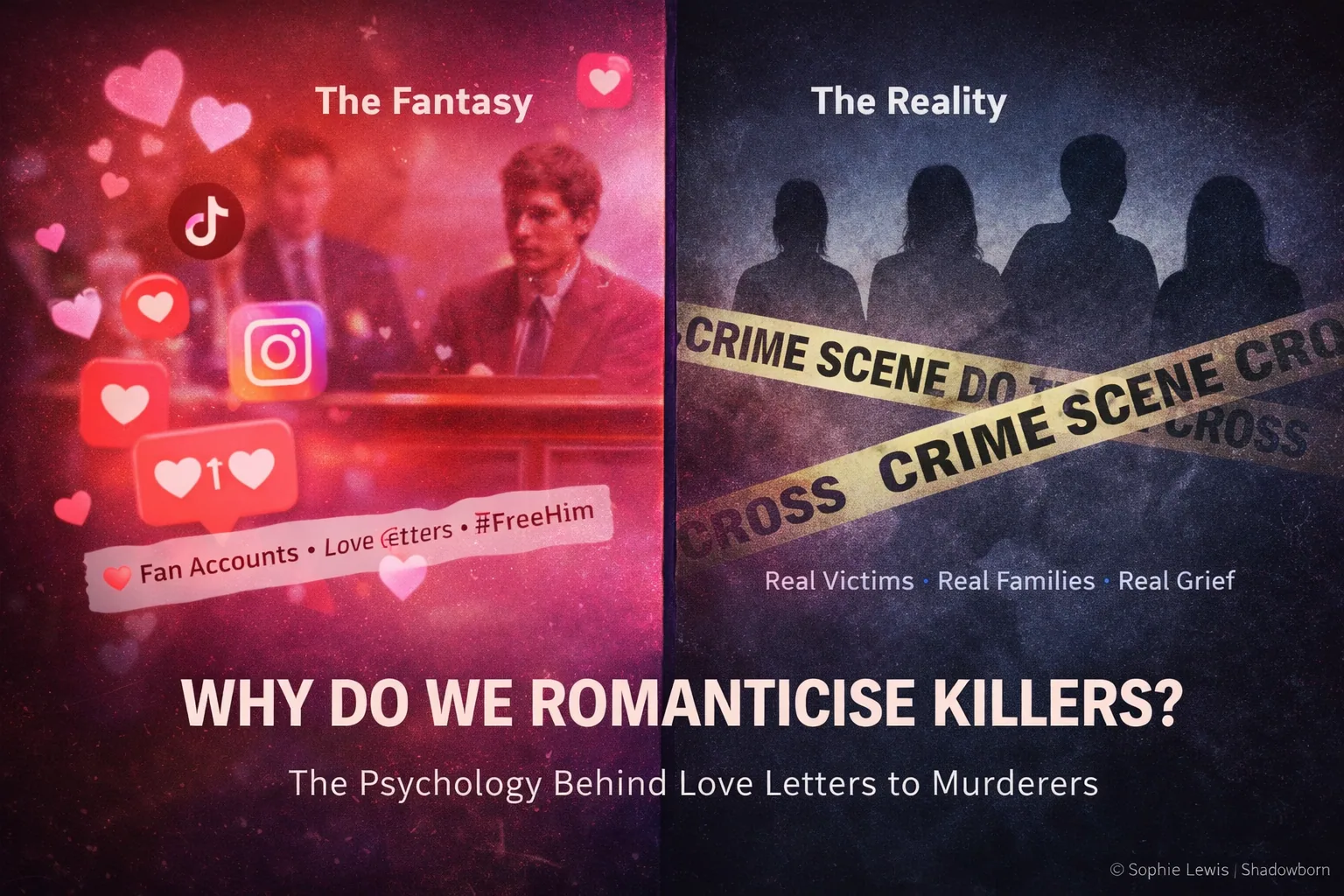
Why Do We Romanticise Killers?
©️ Sophie Lewis | Shadowborn
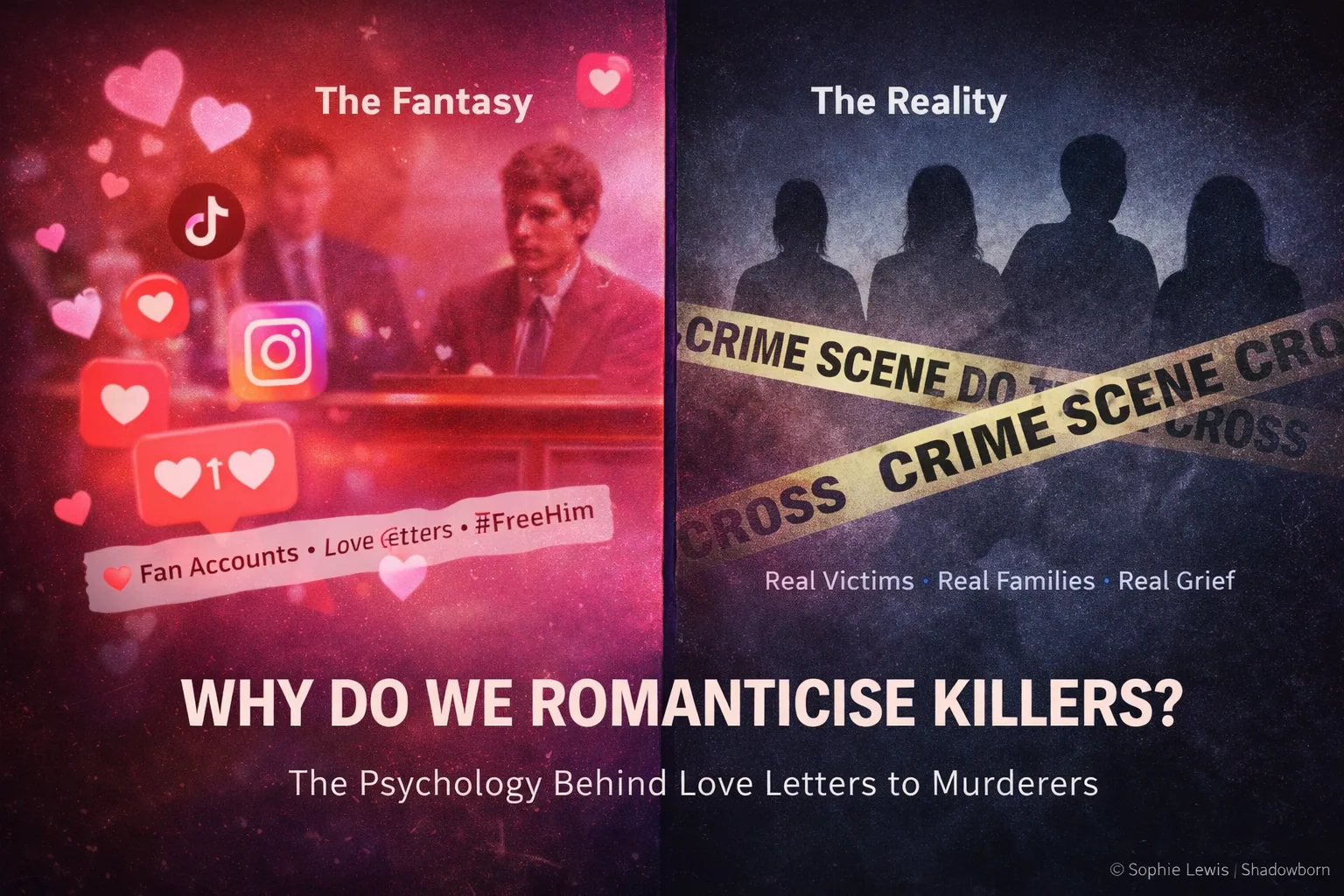
The Psychology Behind Love Letters to Murderers
In 2013, Jodi Arias was convicted of murdering her boyfriend Travis Alexander.
She stabbed him 27 times, slit his throat, and shot him in the head.
During her trial, she received marriage proposals.
Men sent her love letters.
Created fan accounts.
Defended her online.
This isn’t an isolated incident.
Ted Bundy received hundreds of love letters whilst on death row and married one of his groupies.
Richard Ramirez (the Night Stalker) married a fan whilst awaiting execution for murdering 14 people.
The Menendez brothers, who murdered their parents, have active fanbases defending them on TikTok.
Charles Manson had multiple women fighting over him.
Convicted school shooter Nikolas Cruz receives fan mail.
And it’s not just historical cases.
Every high-profile murder trial now comes with:
- Fan accounts on social media
- Fundraisers for legal defence
- TikTok edits set to romantic music
- Online communities defending the killer
- People crying in courtrooms when sentences are announced
Why?
What is it about violent criminals that makes some people fall in love with them?
What Is Hybristophilia?
Hybristophilia is the sexual attraction to people who have committed crimes, particularly violent crimes.
It comes from the Greek:
- Hybris (to commit an outrage against someone)
- Philia (love)
Literally: love of those who commit outrages.
It’s sometimes called “Bonnie and Clyde Syndrome” after the romanticised criminal couple.
Two Types
Psychologists distinguish between two types:
Passive hybristophilia:
- Attracted to the idea of the criminal
- No desire for direct contact
- Consumes media about them
- Creates fan content
- Defends them online
- Examples: TikTok fan accounts, online petitions, watching trial footage repeatedly
Active hybristophilia:
- Seeks direct contact with the criminal
- Writes letters
- Attends trials
- Visits in prison
- Pursues romantic or sexual relationships
- Examples: Women who married Ted Bundy, Richard Ramirez, Erik Menendez
Both types are increasingly common in the social media age.
The Psychology: Why Do People Fall for Killers?
1. The “Bad Boy/Girl” Fantasy
Society has long romanticised the “dangerous” person.
From Gothic literature’s brooding antiheroes to modern films glorifying outlaws, we’re conditioned to find danger attractive.
Why?
- Evolutionary psychology suggests attraction to dominance and fearlessness
- Popular culture reinforces this (vampires, rebels, antiheroes)
- The “bad” person is often portrayed as redeemable
But there’s a massive difference between a fictional character and a real murderer.
When killers have:
- Distinctive appearances (tattoos, good looks, distinctive features)
- Dramatic courtroom moments
- Media coverage that emphasises their “charisma”
- Comparisons to fictional characters
They become aestheticised.
For their fans, they’re not real people who murdered real victims.
They’re characters.
Fantasies.
Aesthetic choices.
2. The “I Can Fix Them” Delusion
Many people who romanticise killers genuinely believe they can “save” them.
They see:
- Troubled childhoods
- Mental health issues
- Substance abuse
- Claims of innocence or wrongful conviction
And think: “They just need love.”
This is rooted in:
Caretaker conditioning – People (especially women) are socialised to nurture and “fix” broken people
Saviour complex – The belief that your love is special enough to change someone
Main character syndrome – “I’m different; I can reach them where others failed”
This requires completely ignoring:
- The victims
- The evidence
- The harm caused
- The reality of who the person actually is
3. The Parasocial Relationship
Social media has transformed how we interact with criminals.
Previous generations might have read about killers in newspapers.
But they didn’t have:
- TikTok fan edits with romantic music
- The ability to create online communities around killers
- Direct messaging and comment sections
- Court footage available on YouTube
- Fan accounts that humanise murderers
This creates parasocial relationships – one-sided connections where people feel like they know someone they’ve never met.
People who support killers:
- Watch court footage on repeat
- Analyse their facial expressions
- Create narratives about who they “really” are
- Build entire online identities around defending them
They feel like they understand them.
Like they have a connection.
But it’s entirely constructed from edited clips and curated content.
4. Trauma Bonding and Attraction to Danger
For some people, attraction to dangerous individuals stems from trauma.
Trauma bonding occurs when:
- You’ve experienced abuse in childhood
- Your brain associates love with danger
- You’re unconsciously drawn to what feels “familiar”
If your formative relationships involved:
- Violence
- Unpredictability
- Fear mixed with affection
Then “safe” people may feel boring.
And dangerous people may feel exciting.
This isn’t a conscious choice.
It’s a neurological pattern established by early experiences.
Important note: Not all people attracted to killers have trauma histories, and not all trauma survivors are attracted to dangerous people. But there is a documented correlation in some cases.
5. The Fantasy of Being “Chosen”
High-profile killers often have multiple admirers.
This creates competition.
And for some people, being “chosen” by someone powerful (even if that power is destructive) feels validating.
Ted Bundy had multiple women pursuing him whilst on death row.
Richard Ramirez received hundreds of letters and ultimately married a fan.
The Menendez brothers have had numerous relationships whilst incarcerated.
For someone who feels invisible, unimportant, or unworthy, being “special” to someone notorious feels significant.
Even if that person is a murderer.
It’s the ultimate “pick me” dynamic.
6. The Denial of Violence
Here’s an uncomfortable truth:
Society teaches us to minimise violence, especially male violence against women.
We’re conditioned with:
- “Boys will be boys”
- “They didn’t mean it”
- “You’re overreacting”
- “What did the victim do to provoke them?”
So when someone commits murder, their supporters automatically defend them.
Not because they condone murder.
But because they’ve been conditioned to:
- Find excuses for violence
- Centre the perpetrator’s feelings
- Blame victims
- Seek explanations that absolve responsibility
Common defences:
- “They have mental health issues”
- “They were on drugs”
- “They had a bad childhood”
- “The system failed them”
- “They’re not a monster, they made a mistake”
All of which may be true.
But none of which change the fact that someone is dead.
7. The Lack of Consequences (For Fans)
There’s no social cost to romanticising a killer online.
You can:
- Create fan accounts
- Post thirst tweets
- Donate to legal defence funds
- Attend trials as a supporter
- Write love letters
And face zero real-world consequences.
Your friends might think you’re odd, but:
- You won’t be arrested
- You won’t lose your job (usually)
- You won’t face legal action
The killer is safely locked away, so the fantasy remains just that: a fantasy.
You get all the excitement of “dating” a dangerous person with none of the actual danger.
The Victims Are Forgotten
Here’s the pattern across every case:
Killers become celebrities.
Victims become footnotes.
Think about it:
Ted Bundy murdered at least 30 women. People remember Bundy’s “charm.” How many victims can you name?
Jeffrey Dahmer murdered 17 people. Netflix made a series about him that romanticised aspects of his life. How many victims can you name?
The Menendez Brothers murdered their parents. TikTok defends them daily. Do you know their parents’ names? (José and Kitty Menendez)
Jodi Arias murdered Travis Alexander. Her trial became entertainment. People focus on whether she’s attractive, not on Travis’s life.
The victims’ families have to watch as:
- Strangers romanticise their loved one’s killer
- Fan accounts crop up on social media
- Fundraisers raise thousands for the killer’s defence
- People cry when the killer is sentenced
It’s a second trauma.
Is This Just a “Women’s Problem”?
No.
Whilst women are more likely to write love letters to male killers, men also romanticise female killers.
Examples:
- Jodi Arias received marriage proposals from men
- Casey Anthony (acquitted of murdering her daughter) had male defenders calling her attractive
- Karla Homolka (Canadian serial killer) received letters from men
- Aileen Wuornos was romanticised in media portrayals
The difference:
When men romanticise female killers, it’s often sexualised (“she’s hot”).
When women romanticise male killers, it’s often emotional (“I can save him”).
Both are problematic.
Both centre the killer over the victim.
The Role of Media
Media plays a massive role in romanticising killers.
True crime documentaries often:
- Focus extensively on the killer’s backstory
- Use dramatic music and cinematography
- Present killers as “complex” or “fascinating”
- Give minimal screen time to victims
- Use attractive actors in dramatisations
Example: Multiple series about Ted Bundy have been criticised for focusing on his “charm” rather than his victims’ stories.
Social media platforms amplify this by:
- Allowing fan accounts to thrive
- Recommending killer content to viewers
- Enabling fundraising for killers’ legal defences
- Creating algorithms that reward engagement (controversy = clicks)
Journalism contributes when:
- Headlines focus on killers’ appearance
- Coverage centres the killer’s psychology over victims’ stories
- Photos emphasise attractiveness
- Trials become entertainment
All of this makes killers famous.
And fame, even infamy, is currency.
Historical Context: This Isn’t New
The romanticisation of criminals isn’t a modern phenomenon.
19th Century:
- Highwaymen were romanticised in literature
- Pirates became folk heroes
- Outlaws like Jesse James were glorified
1920s-1930s:
- Bonnie and Clyde became cultural icons
- John Dillinger had female fans
- “Public enemies” were glamorised in media
1970s onwards:
- Charles Manson received thousands of letters
- Ted Bundy had courtroom groupies
- Serial killers became pop culture figures
What’s changed:
Social media has:
- Accelerated the speed of fan culture
- Made it easier to organize around killers
- Created echo chambers where romanticisation is normalized
- Enabled direct contact (some killers have access to tablets/email)
- Turned trials into entertainment in real-time
The Danger
Romanticising killers isn’t just tasteless.
It’s dangerous.
For society:
- Normalises violence
- Centres perpetrators over victims
- Discourages victims from coming forward
- Sends the message that infamy is attractive
For individuals:
- Can indicate unhealthy attraction patterns
- May stem from unresolved trauma
- Can lead to actual relationships with dangerous people
- Wastes emotional energy on fantasies
For families:
- Retraumatises victims’ loved ones
- Forces them to watch their family member’s killer be celebrated
- Makes grief even more complicated
What Can We Do?
1. Centre the Victims
When discussing these cases:
- Name the victims first
- Tell their stories
- Share their photos (with family permission)
- Remember their humanity
2. Stop Romanticising Violence
Recognise when you’re:
- Making excuses for perpetrators
- Centring the killer’s feelings
- Minimising harm
- Participating in “fan” behaviour around killers
If you find yourself defending someone who committed violence, ask:
“Would I feel this way if the victim was someone I loved?”
3. Understand Your Attractions
If you find yourself attracted to dangerous people:
- Consider therapy to explore why
- Examine your early relationships
- Identify patterns in who you’re drawn to
- Work on building attraction to safe people
Attraction to danger isn’t a character flaw.
But it’s worth understanding where it comes from.
4. Hold Media Accountable
Stop engaging with content that:
- Romanticises killers
- Minimises victims
- Turns murder into entertainment
- Creates “fan content” around perpetrators
Vote with your clicks.
5. Remember: They’re Not Characters
These aren’t fictional antiheroes.
They’re real people who killed real people.
And their victims deserved better than to be forgotten.
Final Thoughts
The romanticisation of killers isn’t new.
But social media has amplified it to an unprecedented degree.
It’s now easier than ever to:
- Build communities around murderers
- Raise money for their legal defences
- Create fan content that erases victims
- Turn violence into entertainment
And it needs to stop.
Not because people who feel these attractions are “bad.”
But because the victims deserve better.
Every person who was murdered had:
- A life
- A family
- Dreams
- A future
They didn’t die so that strangers could romanticise their killer on TikTok.
They were people.
They deserved to live.
And we owe it to them to remember their names, not their killers’.
Resources:
If you’re in a relationship with someone who scares you:
- National Domestic Violence Hotline (US): 1-800-799-7233
- Women’s Aid (UK): 0808 2000 247
If you’re struggling with attraction to dangerous people:
- Consider speaking to a therapist who specialises in trauma and relationship patterns
💔